Home » STP/RSTP/MSTP: Spanning Tree Protocol, Root Bridge, Port Roles, BPDU Guard และ Loop Prevention
STP/RSTP/MSTP: Spanning Tree Protocol, Root Bridge, Port Roles, BPDU Guard และ Loop Prevention
STP/RSTP/MSTP: Spanning Tree Protocol, Root Bridge, Port Roles, BPDU Guard และ Loop Prevention
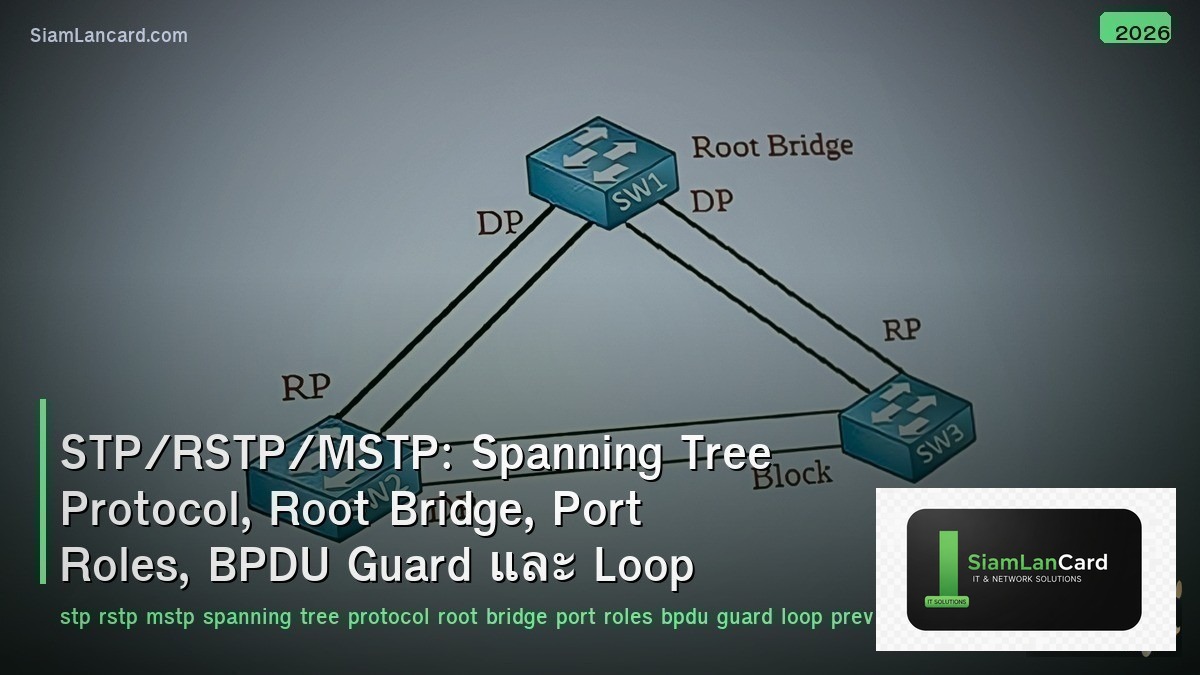
STP (Spanning Tree Protocol) ป้องกัน Layer 2 loops ใน switched networks Root Bridge เป็น switch หลักที่กำหนด topology, Port Roles (Root, Designated, Blocking) กำหนดการ forward/block ของแต่ละ port, RSTP ปรับปรุง convergence จาก 30-50 วินาทีเหลือ 1-2 วินาที, MSTP จัดกลุ่ม VLANs เข้า instances เพื่อ optimize และ BPDU Guard ป้องกัน rogue switches
L2 loops เป็น ปัญหาร้ายแรงที่สุดใน switched networks: broadcast storm จาก single loop สามารถ bring down ทั้ง network ใน seconds เพราะ frames ไม่มี TTL เหมือน IP packets → วนไปเรื่อยๆ → CPU 100% บนทุก switch → network ล่มทั้งหมด STP ป้องกันโดย block redundant paths แต่ยัง forward ได้เมื่อ primary path fail
STP (802.1D) Basics
| Concept |
Description |
| Root Bridge |
Switch ที่มี lowest Bridge ID (priority + MAC) — center of STP topology |
| Bridge ID |
Priority (default 32768) + System ID Extension (VLAN) + MAC address |
| BPDU |
Bridge Protocol Data Unit — messages ที่ switches แลกเปลี่ยนเพื่อ elect root + determine topology |
| Path Cost |
Cost ของ link ตาม bandwidth: 10G=2, 1G=4, 100M=19, 10M=100 |
| Root Path Cost |
Total cost จาก switch ไป Root Bridge (sum of link costs) |
| Convergence |
30-50 seconds (Listening 15s → Learning 15s → Forwarding) |
STP Port Roles
| Role |
Description |
State |
| Root Port |
Best path ไป Root Bridge (lowest root path cost) — 1 per non-root switch |
Forwarding |
| Designated Port |
Best port on each segment ที่ forward traffic toward root — 1 per segment |
Forwarding |
| Blocking (Alternate) |
Redundant port ที่ถูก block เพื่อป้องกัน loop |
Blocking (ไม่ forward) |
| Disabled |
Administratively shut down |
Disabled |
STP Port States
| State |
BPDU |
MAC Learning |
Forwarding |
Duration |
| Blocking |
Receive only |
No |
No |
20s (max age) |
| Listening |
Send + Receive |
No |
No |
15s (forward delay) |
| Learning |
Send + Receive |
Yes |
No |
15s (forward delay) |
| Forwarding |
Send + Receive |
Yes |
Yes |
Stable state |
| Disabled |
None |
No |
No |
Admin shutdown |
RSTP (802.1w) — Rapid Spanning Tree
| Feature |
STP (802.1D) |
RSTP (802.1w) |
| Convergence |
30-50 seconds |
1-2 seconds (sub-second possible) |
| Port Roles |
Root, Designated, Blocking |
Root, Designated, Alternate, Backup |
| Port States |
5 states (Blocking, Listening, Learning, Forwarding, Disabled) |
3 states (Discarding, Learning, Forwarding) |
| Proposal/Agreement |
ไม่มี (ต้องรอ timers) |
Rapid transition ด้วย proposal/agreement handshake |
| Edge Port |
PortFast (Cisco proprietary) |
Edge port (standard) — immediate forwarding |
| Topology Change |
TC notification ไป root → root propagates |
Direct TC notification to all switches (faster) |
MSTP (802.1s) — Multiple Spanning Tree
| Feature |
รายละเอียด |
| คืออะไร |
Map multiple VLANs to STP instances → reduce number of STP calculations |
| vs PVST+ |
PVST+: 1 STP instance per VLAN (100 VLANs = 100 instances) → resource heavy |
| MST Instance |
Group of VLANs sharing same STP topology (e.g., VLANs 1-50 → Instance 1, 51-100 → Instance 2) |
| IST (Instance 0) |
Internal Spanning Tree — default instance, interacts with other MST regions |
| MST Region |
Switches with same: region name + revision number + VLAN-to-instance mapping |
| Load Balancing |
Different root bridge per instance → traffic balanced across redundant links |
| Scalability |
16 instances max (vs 4096 PVST+) — much more efficient |
STP Security Features
| Feature |
Purpose |
Action |
| BPDU Guard |
ป้องกัน rogue switch บน access ports |
Port receives BPDU → err-disable port immediately |
| BPDU Filter |
ไม่ส่งและไม่ receive BPDUs บน port |
Port ไม่ participate ใน STP (ระวัง — อาจสร้าง loop) |
| Root Guard |
ป้องกัน rogue switch จาก becoming root |
Port receives superior BPDU → root-inconsistent (blocking) |
| Loop Guard |
ป้องกัน loop เมื่อ BPDUs หยุด (unidirectional link failure) |
Port stops receiving BPDUs → loop-inconsistent (blocking) |
| PortFast |
Skip listening/learning states บน access ports |
Immediate forwarding (ใช้เฉพาะ access ports — never uplinks) |
| UDLD |
Detect unidirectional links (fiber miswiring) |
Err-disable port if unidirectional detected |
STP Best Practices
| Practice |
Detail |
| Set Root Bridge |
Manually set root bridge (lowest priority) — don’t rely on default MAC-based election |
| Use RSTP/MSTP |
Never use legacy STP (802.1D) — always RSTP or MSTP for fast convergence |
| PortFast + BPDU Guard |
Enable on ALL access ports (end devices) — prevents rogue switches + fast user access |
| Root Guard |
Enable on ports facing access layer — prevent access switches from becoming root |
| L3 at Distribution |
Route at distribution layer → limit STP domain to access-distribution block only |
| Minimize L2 Domain |
Smaller L2 domain = smaller STP domain = less risk of broadcast storms |
ทิ้งท้าย: STP = Essential Loop Prevention, But Minimize Its Scope
STP/RSTP/MSTP STP (802.1D): root bridge election, port roles (root/designated/blocking), 30-50s convergence Port States: blocking → listening → learning → forwarding (STP) | discarding → learning → forwarding (RSTP) RSTP (802.1w): 1-2s convergence, proposal/agreement, alternate/backup ports, edge ports MSTP (802.1s): group VLANs into instances (max 16), MST regions, load balancing per instance Security: BPDU Guard (access ports), Root Guard (distribution), Loop Guard (redundant links), PortFast Best Practices: set root manually, use RSTP/MSTP, PortFast+BPDU Guard on access, L3 at distribution Key: STP is necessary evil in L2 networks — minimize L2 domain size and use modern alternatives (routed access, VXLAN)
อ่านเพิ่มเติมเกี่ยวกับ VXLAN EVPN Fabric BGP EVPN Data Center และ Network Design Patterns Spine-Leaf Campus ที่ siamlancard.com หรือจาก icafeforex.com และ siam2r.com