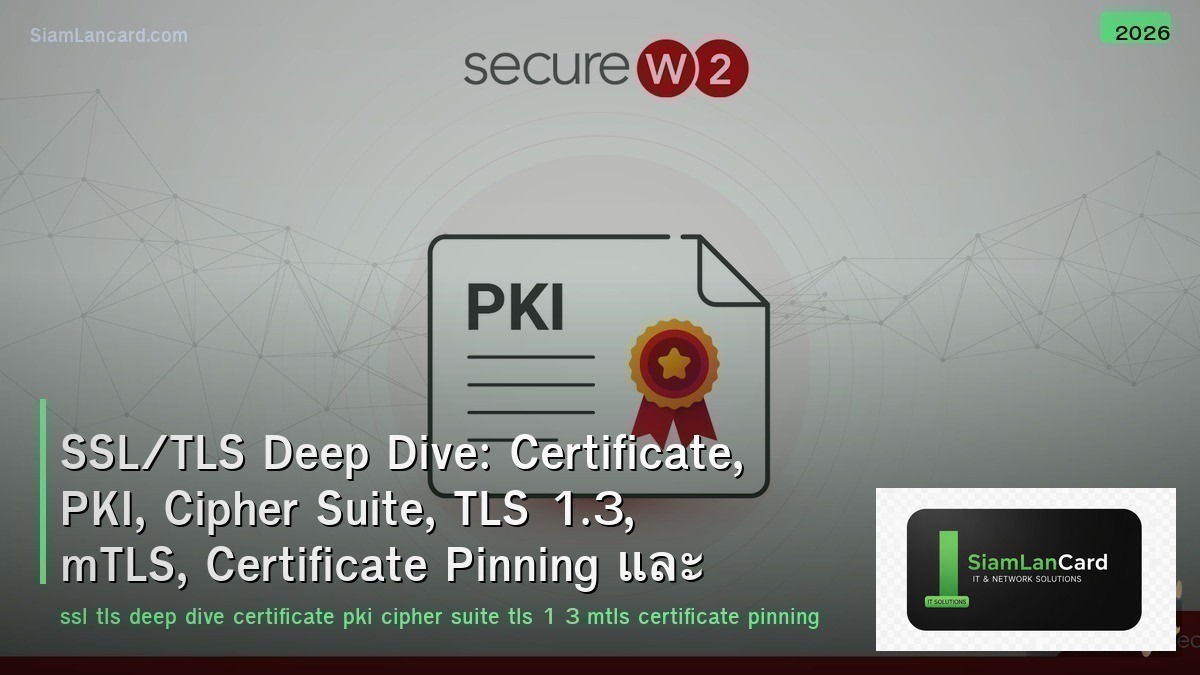
SSL/TLS Deep Dive: Certificate, PKI, Cipher Suite, TLS 1.3, mTLS, Certificate Pinning และ HTTPS

SSL/TLS Deep Dive: Certificate, PKI, Cipher Suite, TLS 1.3, mTLS, Certificate Pinning และ HTTPS

SSL/TLS เป็นพื้นฐานของ internet security ที่ปกป้องข้อมูลระหว่างการส่ง Certificate ยืนยันตัวตนของ server, PKI (Public Key Infrastructure) เป็นระบบจัดการ certificates, Cipher Suite กำหนด algorithms ที่ใช้เข้ารหัส, TLS 1.3 เป็นเวอร์ชันล่าสุดที่เร็วและปลอดภัยกว่า, mTLS ยืนยันตัวตนทั้งสองฝั่ง, Certificate Pinning ป้องกัน man-in-the-middle และ HTTPS คือ HTTP ที่ครอบด้วย TLS

TLS ปกป้อง 90%+ ของ internet traffic: Chrome แสดง “Not Secure” สำหรับ HTTP ทุกเว็บ, Google ให้ ranking boost สำหรับ HTTPS, Let’s Encrypt ออก certificate ฟรี → ทำให้ HTTPS เป็น default TLS 1.3 (2018) ลด handshake จาก 2-RTT เหลือ 1-RTT (และ 0-RTT สำหรับ resumption) → เร็วขึ้น + ตัด cipher suites ที่อ่อนแอออกทั้งหมด → ปลอดภัยขึ้น

TLS Handshake (TLS 1.2 vs 1.3)

Step TLS 1.2 TLS 1.3
Round Trips 2-RTT (Client Hello → Server Hello → Key Exchange → Finished) 1-RTT (Client Hello + Key Share → Server Hello + Key Share → Finished)
Key Exchange RSA or DHE/ECDHE (chosen in handshake) ECDHE only (always forward secrecy)
Cipher Negotiation Client sends list → Server chooses Client sends key shares upfront → faster
0-RTT Resumption Not available Available (PSK) → data in first message (risk: replay attacks)
Encryption Start After handshake complete (2-RTT) After Server Hello (1-RTT) → encrypted earlier

Certificate Types

Type Validation Trust Level Cost
DV (Domain Validation) Verify domain ownership only (DNS/HTTP challenge) Basic — proves domain control Free (Let’s Encrypt) to $50/year
OV (Organization Validation) Verify domain + organization identity (business docs) Medium — proves real organization $50-200/year
EV (Extended Validation) Strict verification: legal entity, physical address, authority Highest — green bar (deprecated in modern browsers) $200-1,000/year
Wildcard (*.domain.com) Covers all subdomains of one level Same as DV/OV/EV base type $50-500/year
SAN/UCC (Multi-Domain) Multiple different domains in one cert Same as base type $100-500/year

PKI (Public Key Infrastructure)

Component Function
Root CA Top of trust chain — self-signed, stored in OS/browser trust store (offline, high security)
Intermediate CA Signed by Root CA — issues end-entity certificates (online, operational)
End-Entity Certificate Server/client certificate — signed by Intermediate CA, presented during TLS handshake
Certificate Chain End-Entity → Intermediate → Root — browser validates entire chain to trusted root
CRL (Certificate Revocation List) List of revoked certificates — downloaded periodically by clients
OCSP Online Certificate Status Protocol — real-time check if cert is revoked (faster than CRL)
OCSP Stapling Server fetches OCSP response → staples to TLS handshake → client doesn’t need to contact CA

Cipher Suites

Component TLS 1.2 Example TLS 1.3
Key Exchange ECDHE (Elliptic Curve Diffie-Hellman Ephemeral) Always ECDHE (built-in)
Authentication RSA or ECDSA (certificate signature) RSA or ECDSA (separate from cipher suite)
Bulk Encryption AES-128-GCM, AES-256-GCM, ChaCha20-Poly1305 Same: AES-128-GCM, AES-256-GCM, ChaCha20
Hash/MAC SHA-256, SHA-384 SHA-256, SHA-384
TLS 1.3 Suites Only 5 suites: TLS_AES_128_GCM_SHA256, TLS_AES_256_GCM_SHA384, TLS_CHACHA20_POLY1305_SHA256
Removed in 1.3 RSA key exchange, CBC mode, RC4, 3DES, MD5, SHA-1 All weak/legacy algorithms eliminated

mTLS (Mutual TLS)

Feature Standard TLS mTLS
Server Auth Yes — server presents certificate Yes — server presents certificate
Client Auth No — client is anonymous Yes — client also presents certificate
Use Case Web browsing, public APIs Service-to-service (microservices), zero trust, API security
Implementation Default TLS behavior Both sides need certificates from same/trusted CA
Service Mesh Istio, Linkerd auto-inject mTLS between all services

Certificate Pinning

Feature Detail
What Application stores expected certificate/public key → rejects any other cert even if valid CA-signed
Protects Against Rogue CA, compromised CA, government-issued fake certs, corporate MITM proxies
HPKP (HTTP) HTTP Public Key Pinning header — deprecated (too risky: pin wrong key = site unusable)
Mobile Apps Common in banking/security apps — pin server cert in app code
Risk Certificate rotation becomes critical — must update pins before cert expires or app breaks
Alternative Certificate Transparency (CT) logs — public log of all issued certs, detect rogue certs

ทิ้งท้าย: TLS = Foundation of Internet Security

SSL/TLS Deep Dive TLS 1.3: 1-RTT handshake (vs 2-RTT in 1.2), 0-RTT resumption, ECDHE only, removed all weak ciphers Certificates: DV (free/basic), OV (org verified), EV (strict), wildcard, SAN — Let’s Encrypt = free DV PKI: Root CA → Intermediate CA → End-Entity, certificate chain validation, CRL/OCSP for revocation Cipher Suites: TLS 1.3 = only 5 strong suites (AES-GCM, ChaCha20), eliminated RSA key exchange, CBC, RC4 mTLS: both sides authenticate — microservices, zero trust, service mesh (Istio/Linkerd) auto-injects Pinning: app stores expected cert/key — protects against rogue CA, common in mobile banking apps Key: TLS 1.3 + strong cipher suites + proper certificate management = secure internet communication

อ่านเพิ่มเติมเกี่ยวกับ Zero Trust Network Identity-Based Access ZTNA SASE และ Network Security Architecture Defense in Depth ที่ siamlancard.com หรือจาก icafeforex.com และ siam2r.com

จัดส่งรวดเร็วส่งด่วนทั่วประเทศ
รับประกันสินค้าเคลมง่าย มีใบรับประกัน
ผ่อนชำระได้บัตรเครดิต 0% สูงสุด 10 เดือน
สะสมแต้ม รับส่วนลดส่วนลดและคะแนนสะสม

© 2026 SiamLancard — จำหน่ายการ์ดแลน อุปกรณ์ Server และเครื่องพิมพ์ใบเสร็จ

SiamLancard
Logo
Free Forex EA Download — XM Signal · EA Forex ฟรี
iCafeForex.com - สอนเทรด Forex | SiamCafe.net
Shopping cart