Home OSPF Advanced: Areas, LSA Types, Stub/NSSA, Virtual Links และ Route Filtering OSPF Advanced: Areas, LSA Types, Stub/NSSA, Virtual Links และ Route Filtering
OSPF Advanced: Areas, LSA Types, Stub/NSSA, Virtual Links และ Route Filtering
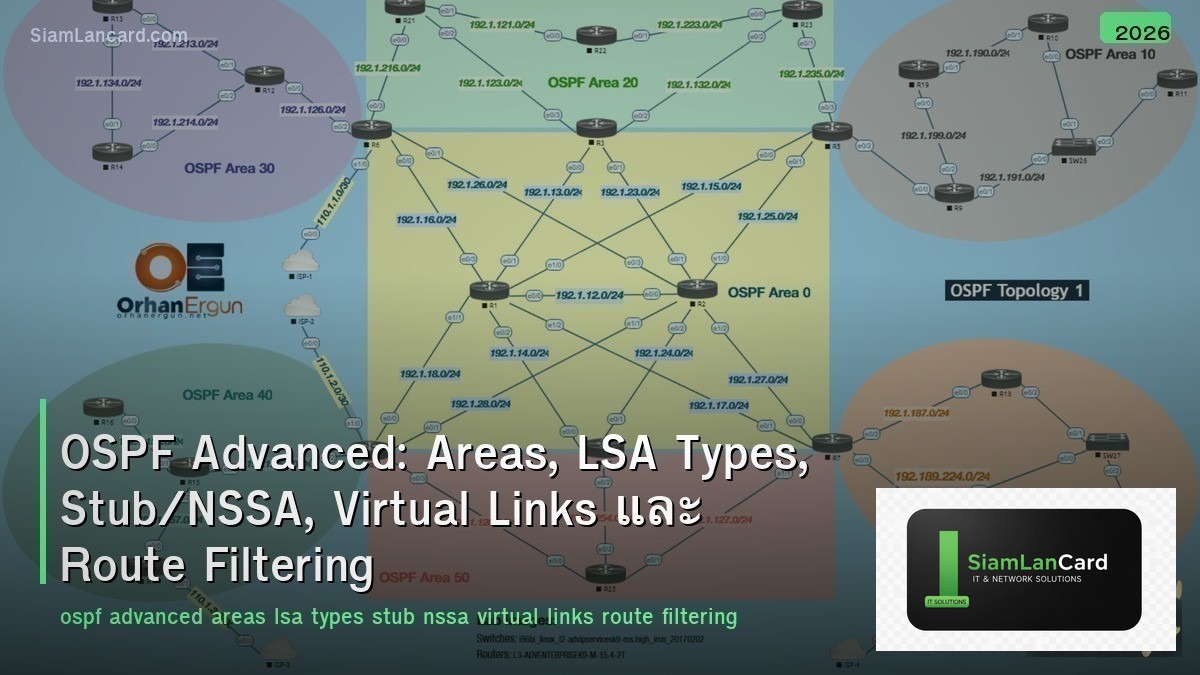
OSPF (Open Shortest Path First) เป็น link-state routing protocol ที่ใช้กันแพร่หลายที่สุดใน enterprise networks OSPF Areas แบ่ง network เป็น hierarchical domains เพื่อลด routing overhead, LSA Types กำหนดประเภทข้อมูลที่ OSPF แลกเปลี่ยน, Stub/NSSA Areas ลด routing table size สำหรับ remote sites, Virtual Links เชื่อม areas ที่ไม่ติด backbone และ Route Filtering ควบคุม routes ที่ OSPF advertise
OSPF single area ทำงานได้ดีใน network เล็ก แต่เมื่อ network ใหญ่ขึ้น single area มีปัญหา : SPF calculation ใช้ CPU สูง, LSDB ใหญ่มาก, topology change กระทบทุก router Proper area design + stub areas + route summarization ลดปัญหาเหล่านี้อย่างมาก
OSPF Area Types
Area Type
LSA 1-2
LSA 3
LSA 4-5
LSA 7
Default Route
Normal Area
✓
✓
✓
✗
Optional
Stub Area
✓
✓
✗
✗
Auto (LSA 3 default)
Totally Stubby
✓
✗ (only default)
✗
✗
Auto (LSA 3 default only)
NSSA
✓
✓
✗
✓
Optional
Totally NSSA
✓
✗ (only default)
✗
✓
Auto (LSA 3 default only)
LSA Types
LSA Type
Name
Generated By
Scope
Type 1
Router LSA
Every router
Within area (describes router’s links)
Type 2
Network LSA
DR on multi-access networks
Within area (describes attached routers)
Type 3
Summary LSA
ABR (Area Border Router)
Between areas (inter-area routes)
Type 4
ASBR Summary LSA
ABR
Between areas (reach ASBR)
Type 5
External LSA
ASBR
Entire OSPF domain (external routes)
Type 7
NSSA External LSA
ASBR in NSSA
Within NSSA (converted to Type 5 at ABR)
Stub Area
Feature
รายละเอียด
Purpose
ลด routing table + LSDB size โดยไม่รับ external routes (LSA 4-5)
ABR Injects
Default route (LSA 3) เข้า stub area → routers ใน area ใช้ default ออกไปข้างนอก
Restriction
ไม่มี ASBR ใน stub area (ห้าม redistribute เข้า stub area)
All Routers
ทุก router ใน area ต้อง configure เป็น stub (ไม่งั้น adjacency ไม่ขึ้น)
Use Case
Remote/branch offices ที่มีทางออกเดียว (ไม่ต้องรู้ external routes ทั้งหมด)
NSSA (Not-So-Stubby Area)
Feature
รายละเอียด
Purpose
เหมือน stub area แต่ allow external routes เข้ามาผ่าน LSA Type 7
LSA Type 7
External routes ใน NSSA ใช้ LSA 7 (แทน LSA 5 ที่ถูก block)
7-to-5 Translation
ABR convert LSA 7 → LSA 5 เพื่อ flood ไปทั้ง OSPF domain
Use Case
Branch office ที่มี local internet (redistribute static/connected) แต่ไม่ต้องการ external routes จากที่อื่น
Virtual Links
Feature
รายละเอียด
Purpose
เชื่อม area ที่ไม่ adjacent กับ Area 0 (backbone) ผ่าน transit area
Rule
ทุก area ต้อง connect กับ Area 0 → ถ้าไม่ได้ → ใช้ virtual link
Transit Area
Area ที่ virtual link ผ่าน (ต้องเป็น normal area ไม่ใช่ stub)
Configuration
Configure บน ABRs ทั้ง 2 ฝั่ง (point-to-point virtual link)
Temporary
Virtual link ควรเป็น temporary solution → redesign network ให้ทุก area ติด Area 0
Route Summarization
Type
Where
Command Concept
Inter-Area Summarization
ABR (area border router)
Summarize routes จาก area หนึ่งก่อน advertise ไปอีก area
External Summarization
ASBR
Summarize external routes ก่อน redistribute เข้า OSPF
Benefit
ลด routing table size
ลด LSA flooding, ลด SPF calculations, ซ่อน topology changes
Route Filtering
Method
Where
How
Distribute-list
ที่ router ใดๆ
Filter routes จาก routing table (ไม่ได้ filter LSAs)
Area filter-list
ABR
Filter LSA Type 3 ระหว่าง areas (prefix-list based)
LSA Type 3 filtering
ABR (totally stubby)
Block ทุก LSA 3 ยกเว้น default (totally stubby area)
Route-map on redistribution
ASBR
Filter/modify routes เมื่อ redistribute เข้า/ออก OSPF
OSPF database filter
Per-interface
Prevent sending LSA updates ออก specific interface
OSPF Design Best Practices
Practice
รายละเอียด
Area 0 as Backbone
ทุก area ต้อง connect กับ Area 0 (hub of OSPF domain)
Max Routers per Area
50-100 routers per area (beyond = performance issues)
Summarize at ABR
Summarize routes ที่ ABR ก่อนส่งข้าม area (ลด LSA flooding)
Stub Areas for Branches
ใช้ stub/totally stubby สำหรับ branch offices (ลด routing table)
NSSA for Local Internet
Branch ที่มี local internet → NSSA (allow redistribute)
Avoid Virtual Links
Virtual links = temporary fix → redesign to eliminate
BFD for Fast Failover
BFD (Bidirectional Forwarding Detection) → sub-second failure detection
Authentication
MD5 หรือ SHA authentication ทุก OSPF adjacency (prevent rogue routers)
ทิ้งท้าย: OSPF Areas = Scalable, Hierarchical Routing
OSPF Advanced Areas: divide OSPF into hierarchical domains (reduce SPF computation + LSDB size) LSA Types: 1 (router), 2 (network), 3 (summary), 4 (ASBR summary), 5 (external), 7 (NSSA) Stub: block external routes (LSA 4-5) → inject default route Totally Stubby: block everything except default (smallest routing table) NSSA: stub + allow local external routes via LSA 7 Virtual Links: temporary fix for areas not connected to Area 0 Design: 50-100 routers/area, summarize at ABR, stub for branches, BFD for fast failover
อ่านเพิ่มเติมเกี่ยวกับ BGP Advanced Route Reflectors และ Segment Routing SR-MPLS SRv6 ที่ siamlancard.com หรือจาก icafeforex.com และ siam2r.com