Home » Network Virtualization: NFV, VNF, MANO, Service Chaining และ uCPE
Network Virtualization: NFV, VNF, MANO, Service Chaining และ uCPE
Network Virtualization: NFV, VNF, MANO, Service Chaining และ uCPE
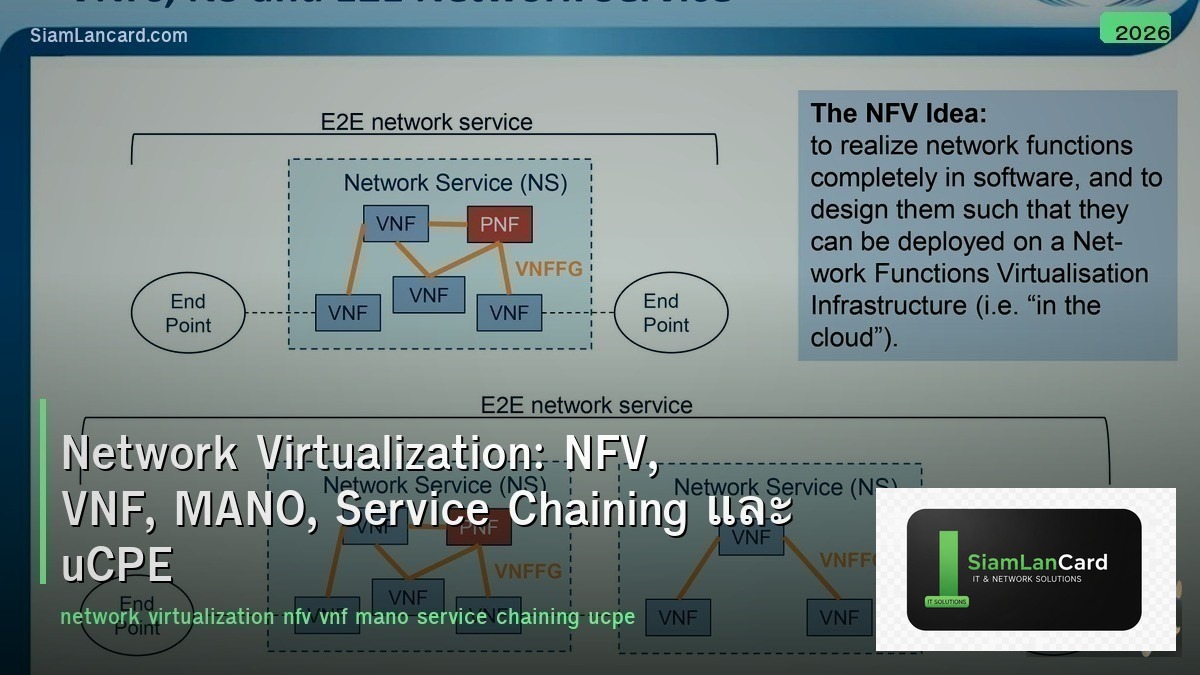
Network Virtualization เปลี่ยน network functions จาก dedicated hardware เป็น software ที่ run บน commodity servers NFV (Network Functions Virtualization) เป็น framework สำหรับ virtualize network services, VNF (Virtual Network Function) คือ network function ที่ run เป็น VM/container, MANO (Management and Orchestration) จัดการ lifecycle ของ VNFs, Service Chaining เชื่อม VNFs ตามลำดับเพื่อสร้าง network service และ uCPE (Universal CPE) นำ NFV ไปไว้ที่ customer premises
องค์กรและ service providers ใช้เงินมหาศาลกับ proprietary hardware appliances (firewall box, load balancer box, WAN optimizer box) ที่แพง, upgrade ยาก, scale ไม่ได้ NFV เปลี่ยน hardware-centric ไปเป็น software-centric: deploy network functions ใน minutes แทน months, scale up/down ตาม demand, ลด CAPEX/OPEX 30-50%
NFV Architecture (ETSI)
| Layer |
Component |
Role |
| VNF Layer |
Virtual Network Functions |
Virtualized network services (firewall, router, load balancer, etc.) |
| NFVI Layer |
NFV Infrastructure |
Compute + storage + network resources (servers, switches, storage) |
| MANO Layer |
Management & Orchestration |
Lifecycle management, resource orchestration, service orchestration |
MANO Components
| Component |
Role |
รายละเอียด |
| NFVO (NFV Orchestrator) |
Service orchestration |
Orchestrate end-to-end network services (chain VNFs together) |
| VNFM (VNF Manager) |
VNF lifecycle |
Instantiate, configure, scale, heal, terminate VNFs |
| VIM (Virtualized Infrastructure Manager) |
Infrastructure management |
Manage compute/storage/network resources (OpenStack, VMware, K8s) |
Common VNFs
| VNF |
Hardware Equivalent |
Examples |
| vFirewall |
Physical firewall (Palo Alto, FortiGate) |
VM-Series (Palo Alto), FortiGate-VM, pfSense |
| vRouter |
Physical router (Cisco, Juniper) |
CSR 1000v (Cisco), vMX (Juniper), VyOS |
| vLoad Balancer |
Physical ADC (F5, Citrix) |
F5 BIG-IP VE, HAProxy, NGINX Plus |
| vWAN Optimizer |
Physical WAN optimizer (Riverbed) |
Silver Peak VX, Riverbed SteelHead-v |
| vIDS/IPS |
Physical IDS/IPS appliance |
Snort, Suricata (as VNF) |
| vDNS |
Physical DNS appliance |
BIND, Unbound, Infoblox vNIOS |
| vEPC/5G Core |
Physical mobile core |
Open5GS, free5GC (virtualized 5G core) |
Service Chaining
| Feature |
รายละเอียด |
| คืออะไร |
เชื่อม VNFs ตามลำดับเพื่อสร้าง network service ที่สมบูรณ์ |
| Example Chain |
Traffic → vFirewall → vIPS → vLoad Balancer → Web Server |
| Dynamic |
เปลี่ยน chain ได้ตาม policy (e.g., add vWAN Opt สำหรับ WAN traffic) |
| NSH (Network Service Header) |
RFC 8300 — header ที่บอกว่า packet อยู่ที่ไหนใน service chain |
| SFC (Service Function Chaining) |
IETF framework สำหรับ steering traffic ผ่าน ordered set ของ service functions |
| Implementation |
OpenStack (networking-sfc), OVS, VMware NSX, Cisco ACI |
uCPE (Universal CPE)
| Feature |
รายละเอียด |
| คืออะไร |
White-box server ที่ customer site ที่ run multiple VNFs (แทน multiple boxes) |
| Before uCPE |
แต่ละ function = 1 box (router box + firewall box + WAN opt box = 3 boxes) |
| After uCPE |
1 white-box server run vRouter + vFirewall + vWAN Opt (3 VNFs, 1 box) |
| Management |
Central management from cloud/NOC → remote deploy/update VNFs |
| Vendors |
Dell (VEP), HPE (EL8000), Lanner, Advantech |
| Benefit |
ลด hardware, ลด truck rolls, deploy new services remotely |
NFV vs Traditional
| Feature |
Traditional |
NFV |
| Hardware |
Proprietary appliances (vendor lock-in) |
Commodity x86 servers (open) |
| Deployment Time |
Weeks-months (procurement + install) |
Minutes-hours (software deployment) |
| Scaling |
Buy more hardware (manual, slow) |
Spin up more VMs/containers (automated, fast) |
| Cost |
High CAPEX + OPEX |
Lower CAPEX (commodity HW) + lower OPEX (automation) |
| Flexibility |
Fixed function per box |
Any function on any server (software-defined) |
| Lifecycle |
5-7 year refresh cycles |
Continuous updates (software upgrade, no HW change) |
NFV Platforms
| Platform |
Type |
จุดเด่น |
| OpenStack |
VIM (cloud platform) |
De facto standard for NFV infrastructure, open source |
| Kubernetes |
Container orchestration |
Cloud-native VNFs (CNFs), microservices, auto-scaling |
| VMware vSphere |
Virtualization platform |
Enterprise standard, vRealize for management |
| ONAP |
MANO (orchestration) |
Linux Foundation, carrier-grade, end-to-end orchestration |
| OSM (Open Source MANO) |
MANO |
ETSI-hosted, lightweight MANO implementation |
| Cisco NFVIS |
uCPE platform |
Enterprise NFV on ENCS hardware |
CNF vs VNF
| Feature |
VNF (VM-based) |
CNF (Container-based) |
| Runtime |
Virtual Machine (full OS) |
Container (shared kernel, lightweight) |
| Startup |
Minutes |
Seconds |
| Resource |
Heavy (GB of RAM per VNF) |
Light (MB of RAM per CNF) |
| Orchestration |
OpenStack / VMware |
Kubernetes |
| Scaling |
Slower (VM provisioning) |
Fast (container scaling, HPA) |
| Maturity |
Mature (established ecosystem) |
Growing (cloud-native trend) |
| Trend |
Legacy workloads |
New deployments (5G core, edge) |
ทิ้งท้าย: NFV = Software-Defined Network Functions
Network Virtualization NFV: virtualize network functions (hardware → software on commodity servers) VNF: virtual network functions (vFirewall, vRouter, vLB, vWAN Opt) MANO: NFVO (orchestration) + VNFM (lifecycle) + VIM (infrastructure) Service Chaining: connect VNFs in sequence (traffic → FW → IPS → LB → server) uCPE: single white-box at customer site running multiple VNFs CNF: next evolution — container-based NFs on Kubernetes (faster, lighter) Benefits: deploy in minutes, scale on demand, reduce CAPEX/OPEX 30-50%
อ่านเพิ่มเติมเกี่ยวกับ Container Networking Kubernetes CNI และ Cloud Networking AWS VPC ที่ siamlancard.com หรือจาก icafeforex.com และ siam2r.com