Home » Network Redundancy: HSRP, VRRP, GLBP, Stacking, MLAG และ High Availability
Network Redundancy: HSRP, VRRP, GLBP, Stacking, MLAG และ High Availability
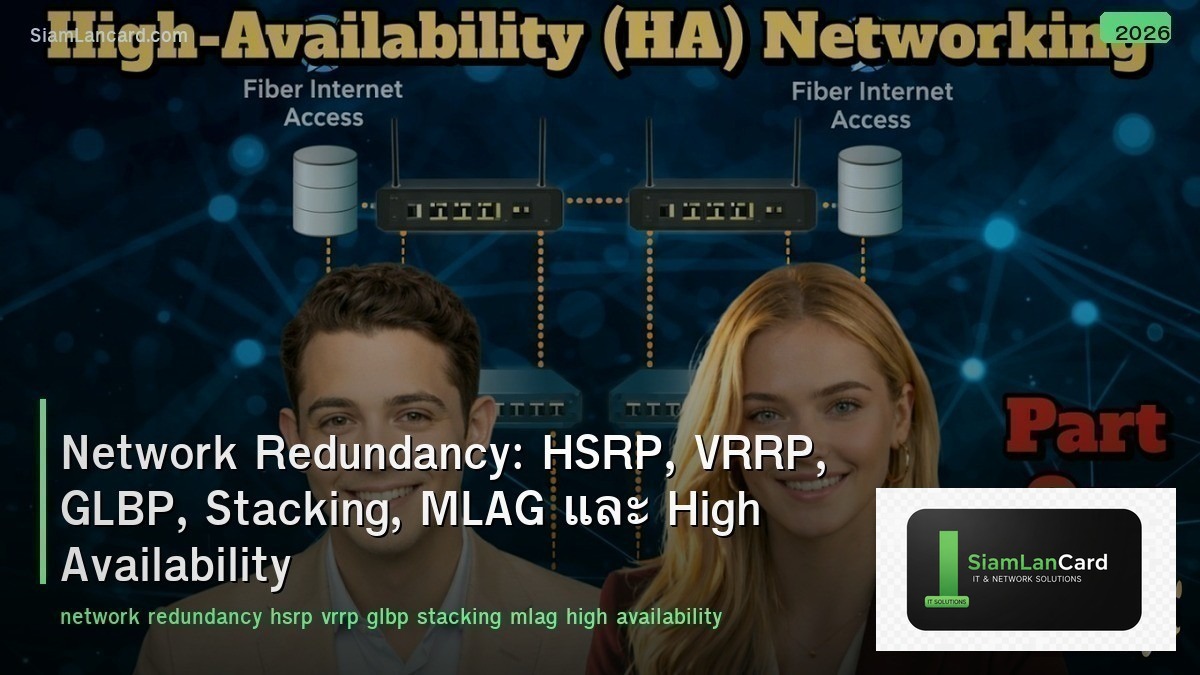
Network Redundancy: HSRP, VRRP, GLBP, Stacking, MLAG และ High Availability
Network Redundancy ออกแบบให้ network ทำงานต่อเนื่องแม้มี component failure HSRP (Hot Standby Router Protocol) ให้ virtual gateway ที่ failover อัตโนมัติ, VRRP เป็น open standard เดียวกัน, GLBP เพิ่ม load balancing ข้าม routers, Stacking รวม switches หลายตัวเป็นตัวเดียว และ MLAG (Multi-Chassis Link Aggregation) ให้ dual-homed connections โดยไม่ต้อง STP blocking
Downtime ของ network มีค่าใช้จ่ายสูง: เฉลี่ย $5,600 ต่อนาที สำหรับ enterprise ตาม Gartner Single point of failure ที่ไหนก็ตาม (router, switch, link, power) สามารถทำให้ทั้ง network ล่มได้ Redundancy design ที่ถูกต้องลด downtime จาก hours เหลือ seconds หรือ sub-second
First Hop Redundancy Protocols
| Feature |
HSRP |
VRRP |
GLBP |
| Standard |
Cisco proprietary |
IETF RFC 5798 (open) |
Cisco proprietary |
| Active/Standby |
1 Active + 1 Standby + listeners |
1 Master + backups |
1 AVG + up to 4 AVF |
| Load Balancing |
ไม่มี (ใช้ได้แค่ Active router) |
ไม่มี (ใช้ได้แค่ Master) |
มี (distribute traffic ข้าม routers) |
| Virtual IP |
ต่างจาก interface IP |
สามารถเป็น interface IP ได้ |
ต่างจาก interface IP |
| Preempt |
Disabled by default |
Enabled by default |
Enabled by default |
| Timer |
Hello 3s, Hold 10s |
Advertisement 1s, Master down 3s |
Hello 3s, Hold 10s |
| Failover |
~10 seconds (default) |
~3 seconds (default) |
~10 seconds (default) |
| Millisecond Failover |
Hello 200ms, Hold 700ms |
Advert 100ms |
Hello 200ms, Hold 700ms |
HSRP
| Feature |
รายละเอียด |
| คืออะไร |
Cisco protocol สำหรับ gateway redundancy (RFC 2281 informational) |
| Virtual IP |
Clients ชี้ default gateway ไปที่ Virtual IP (ไม่ใช่ router IP จริง) |
| Active Router |
Router ที่ตอบ ARP สำหรับ Virtual IP และ forward traffic |
| Standby Router |
Router ที่รอ takeover ถ้า Active ล้ม |
| Priority |
0-255 (default 100), สูงสุด = Active |
| Preempt |
ถ้า enable → router ที่ priority สูงกว่ากลับมา → ชิง Active คืน |
| Tracking |
Track interface/object → ถ้า track ล้ม → ลด priority → trigger failover |
| HSRPv2 |
Extended group range (0-4095), IPv6 support, millisecond timers |
GLBP (Gateway Load Balancing Protocol)
| Feature |
รายละเอียด |
| AVG (Active Virtual Gateway) |
1 router เป็น AVG → assign virtual MACs ให้ AVFs |
| AVF (Active Virtual Forwarder) |
แต่ละ router เป็น AVF → forward traffic ด้วย virtual MAC ที่ได้รับ |
| Load Balancing Methods |
Round-robin (default), weighted, host-dependent |
| ข้อดี |
ใช้ bandwidth ของทุก router (ไม่มี standby idle) |
| ข้อเสีย |
Complex, Cisco-only, debugging ยากกว่า HSRP/VRRP |
Switch Stacking
| Feature |
รายละเอียด |
| คืออะไร |
รวม switches หลายตัว (2-8) ให้ทำงานเป็น logical switch ตัวเดียว |
| Stack Master |
1 switch เป็น master (control plane) ตัวอื่นเป็น members |
| Single Management |
1 IP, 1 config, 1 CLI สำหรับทั้ง stack |
| Cross-Stack LAG |
EtherChannel members ข้าม switch ใน stack ได้ (ไม่ต้อง MLAG) |
| Cisco StackWise |
StackWise-80/160/480 (Catalyst 9200/9300 series) |
| Juniper VC |
Virtual Chassis (EX series) |
| Limitation |
Stack cable failure = split brain, limited distance (1-3m cable) |
MLAG / MC-LAG
| Feature |
รายละเอียด |
| คืออะไร |
Multi-Chassis Link Aggregation — LAG across 2 independent switches |
| How |
2 switches sync state (peer-link) → downstream device เห็นเป็น 1 logical switch |
| No STP Blocking |
ทั้ง 2 uplinks active (ไม่มี STP blocking — all links forwarding) |
| Cisco vPC |
Virtual PortChannel (Nexus series) — peer-link + peer-keepalive |
| Arista MLAG |
MLAG domain — peer-link + MLAG interfaces |
| Juniper MC-LAG |
Multi-Chassis LAG (QFX/EX series) — ICL (Inter-Chassis Link) |
| Advantage |
Active-active uplinks, no STP, immediate failover |
| Consideration |
Peer-link sizing (carry orphan traffic), peer-keepalive for split-brain detection |
Redundancy Design per Layer
| Layer |
Redundancy Method |
| Default Gateway |
HSRP/VRRP/GLBP (virtual gateway failover) |
| Access → Distribution Links |
Dual uplinks + MLAG/vPC (active-active, no STP blocking) |
| Distribution → Core Links |
L3 ECMP (multiple equal-cost paths via OSPF/BGP) |
| Switch Level |
Stacking (single logical switch) or MLAG (dual switches) |
| Supervisor/Control Plane |
Dual supervisors (SSO — Stateful Switchover, NSF — Non-Stop Forwarding) |
| Power |
Dual power supplies + UPS + generator |
| WAN Links |
Dual ISP / MPLS + Internet / SD-WAN multi-path |
High Availability Metrics
| Availability |
Downtime/Year |
Downtime/Month |
| 99% (two nines) |
3.65 days |
7.3 hours |
| 99.9% (three nines) |
8.76 hours |
43.8 minutes |
| 99.99% (four nines) |
52.6 minutes |
4.38 minutes |
| 99.999% (five nines) |
5.26 minutes |
26.3 seconds |
| 99.9999% (six nines) |
31.5 seconds |
2.63 seconds |
ทิ้งท้าย: Redundancy = No Single Point of Failure
Network Redundancy FHRP: HSRP (Cisco), VRRP (open standard), GLBP (Cisco + load balancing) Stacking: multiple switches = 1 logical switch (StackWise, Virtual Chassis) MLAG: active-active uplinks across 2 switches (vPC, MLAG, MC-LAG) — no STP blocking L3 ECMP: multiple equal-cost paths at distribution/core (OSPF/BGP) HA: dual supervisors (SSO/NSF), dual power, dual WAN links Targets: 99.99% = 52 min/year downtime, 99.999% = 5 min/year Design: redundancy at every layer → gateway + links + switches + power + WAN
อ่านเพิ่มเติมเกี่ยวกับ Network Design Patterns Spine-Leaf และ EVPN-VXLAN Data Center ที่ siamlancard.com หรือจาก icafeforex.com และ siam2r.com