Home Multicast Networking: IGMP, PIM, MSDP, Anycast RP, Multicast VPN และ IPTV Architecture Multicast Networking: IGMP, PIM, MSDP, Anycast RP, Multicast VPN และ IPTV Architecture
Multicast Networking: IGMP, PIM, MSDP, Anycast RP, Multicast VPN และ IPTV Architecture
Multicast Networking ส่ง data จาก 1 source ไปหลาย receivers อย่างมีประสิทธิภาพ IGMP ให้ hosts แจ้ง router ว่าต้องการ join/leave multicast group, PIM สร้าง multicast distribution tree, MSDP แชร์ source information ระหว่าง RPs, Anycast RP ให้ redundancy สำหรับ rendezvous point, Multicast VPN ส่ง multicast ข้าม MPLS/VPN และ IPTV Architecture ใช้ multicast สำหรับ live TV delivery
Unicast ส่ง 1 copy per receiver : ถ้ามี 1,000 clients ดู live stream → server ส่ง 1,000 copies → bandwidth = 1,000 × bitrate Multicast ส่ง 1 copy → network replicates ที่ branching points → bandwidth = 1 × bitrate (at source) IPTV operators ใช้ multicast สำหรับ live TV channels: 500 channels × 8 Mbps = 4 Gbps (multicast) vs 500 × 8 Mbps × 10,000 viewers = 40 Tbps (unicast) → impossible without multicast
Multicast Addressing
Range
Purpose
Example
224.0.0.0/24
Local network control (link-local, TTL=1)
224.0.0.1 (all hosts), 224.0.0.5 (OSPF), 224.0.0.13 (PIM)
224.0.1.0/24
Internetwork control
224.0.1.1 (NTP), 224.0.1.40 (Cisco RP announce)
232.0.0.0/8
Source-Specific Multicast (SSM)
Receiver specifies exact source + group → no RP needed
239.0.0.0/8
Administratively scoped (private, like RFC 1918)
Organization internal multicast
MAC Mapping
01:00:5E + last 23 bits of IP
224.1.2.3 → 01:00:5E:01:02:03
IGMP (Internet Group Management Protocol)
Version
Feature
Use
IGMPv1
Join only — no explicit leave (timeout-based)
Legacy — rarely used
IGMPv2
Join + explicit Leave → faster leave (prune)
Standard for most networks
IGMPv3
Source filtering: join (S,G) → receive from specific source only
Required for SSM (Source-Specific Multicast)
IGMP Snooping
Switch learns which ports have multicast receivers → forward only to those ports
Must enable on L2 switches (prevent flooding multicast to all ports)
IGMP Querier
Router sends periodic queries → hosts respond with membership → maintain group state
One querier per subnet (lowest IP wins)
PIM (Protocol Independent Multicast)
Mode
How
Use Case
PIM Dense Mode (DM)
Flood everywhere → prune where not needed (flood-and-prune)
Small networks, many receivers (lab/test only)
PIM Sparse Mode (SM)
Explicit join to RP → build shared tree (*,G) → optional switch to source tree (S,G)
Standard enterprise/SP (most common)
PIM SSM
No RP — receivers specify source directly → (S,G) tree only
IPTV, known source applications (IGMPv3 required)
PIM BiDir
Bidirectional shared tree → traffic flows both to and from RP
Many-to-many applications (video conferencing)
PIM Sparse Mode Trees
Tree
Notation
Description
Shared Tree (RPT)
(*,G)
Traffic goes: Source → RP → Receivers (may not be optimal path)
Source Tree (SPT)
(S,G)
Traffic goes: Source → Receivers directly (shortest path, optimal)
SPT Switchover
Threshold
After receiving traffic via RPT → DR switches to SPT for better path (default: immediate)
RP (Rendezvous Point)
Meeting point
Sources register with RP → receivers join RP → RP connects source to receivers
RP Discovery
Method
How
Use Case
Static RP
Manually configure RP address on all routers
Small networks, simple
Auto-RP (Cisco)
RP announces itself → mapping agent distributes RP-to-group mapping
Cisco-only environments
BSR (Bootstrap Router)
BSR collects RP candidates → distributes to all PIM routers (RFC standard)
Multi-vendor environments
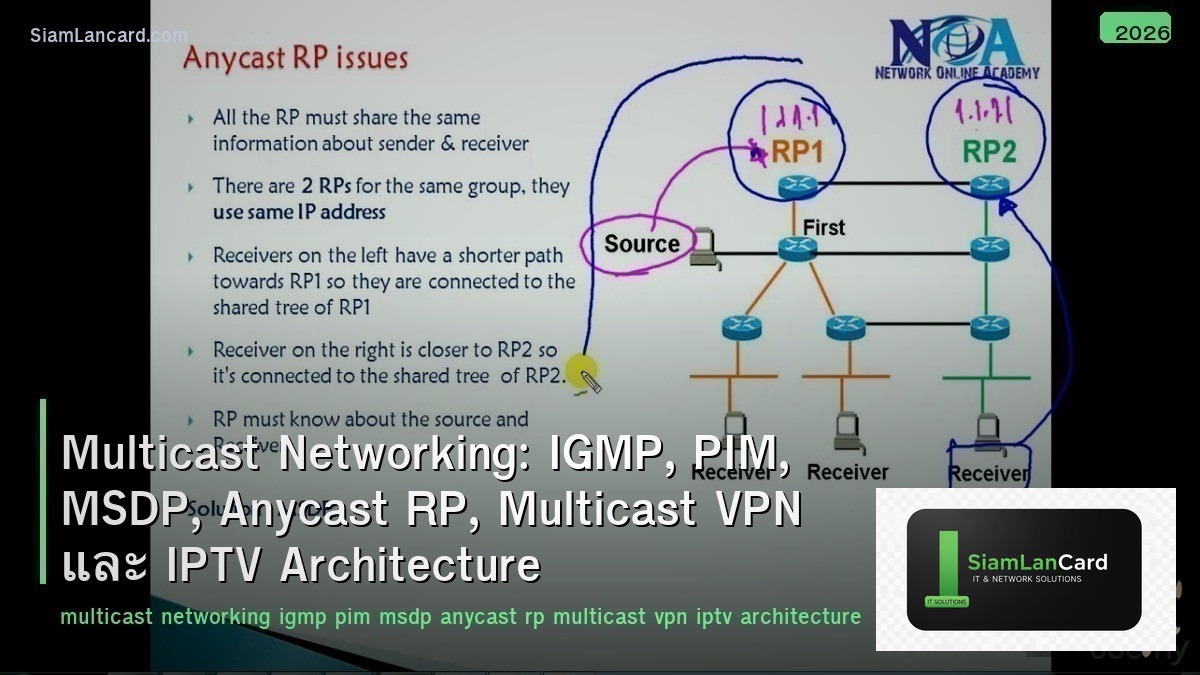
Anycast RP + MSDP
Multiple RPs share same IP (anycast) + MSDP syncs source state
Redundancy + load sharing
Anycast RP + PIM
Multiple RPs same IP → PIM Anycast RP set (RFC 4610) → no MSDP needed
Modern approach (replaces MSDP)
MSDP (Multicast Source Discovery Protocol)
Feature
รายละเอียด
คืออะไร
Share multicast source information between RPs ใน different PIM domains
SA Message
RP sends Source Active (SA) messages to MSDP peers → inform about active sources
Anycast RP
Main use today: sync source state between Anycast RPs (same IP, different routers)
Inter-Domain
Original use: share sources between different multicast domains/ASes
Replaced By
PIM Anycast RP (RFC 4610) ใน single domain → MSDP ยังใช้สำหรับ inter-domain
IPTV Architecture
Component
Function
Head-End
Receive satellite/cable feeds → encode/transcode → multicast streams
Core Network
PIM SSM → distribute multicast streams from head-end to edge
Edge/Access
IGMP snooping on DSLAM/OLT → deliver only subscribed channels to customer
STB (Set-Top Box)
Customer device → sends IGMP join/leave → receives and decodes stream
Channel Change
STB sends IGMP leave (old channel) + IGMP join (new channel) → target < 1 second
VOD (Video on Demand)
Unicast (not multicast) — individual stream per customer request
ทิ้งท้าย: Multicast = Efficient One-to-Many Delivery
Multicast Networking IGMP: v2 (join/leave), v3 (source filtering for SSM), snooping (L2 switch optimization) PIM: dense (flood-prune, avoid), sparse (RP-based, standard), SSM (no RP, known source), BiDir (many-to-many) Trees: shared (*,G) via RP → switch to source (S,G) for optimal path RP: static, Auto-RP (Cisco), BSR (standard), Anycast RP (redundancy) MSDP: sync source state between RPs — used with Anycast RP or inter-domain IPTV: head-end → PIM SSM core → IGMP snooping edge → STB channel change < 1s Key: multicast saves massive bandwidth for live streaming/IPTV — PIM SM + SSM are the standards for enterprise and SP
อ่านเพิ่มเติมเกี่ยวกับ OSPF Deep Dive Areas LSA Types และ QoS Quality of Service DiffServ DSCP ที่ siamlancard.com หรือจาก icafeforex.com และ siam2r.com