Home » MPLS Deep Dive: Labels, LSP, LDP, RSVP-TE, VPN L3/L2, Traffic Engineering และ Segment Routing
MPLS Deep Dive: Labels, LSP, LDP, RSVP-TE, VPN L3/L2, Traffic Engineering และ Segment Routing
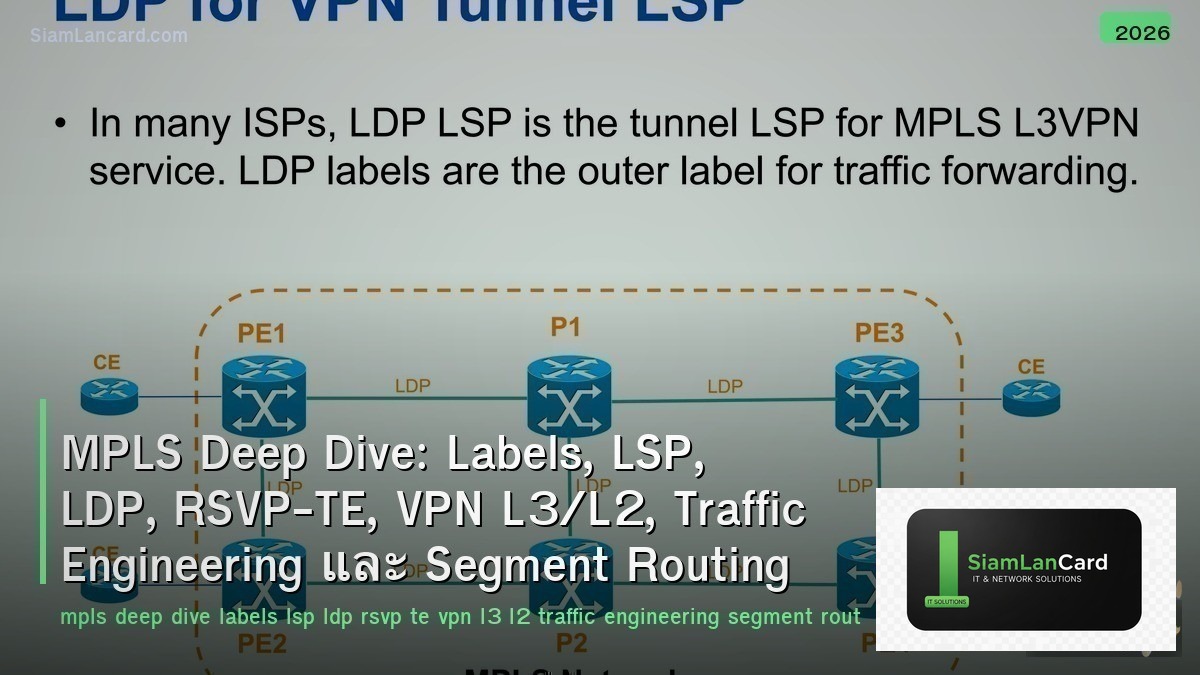
MPLS Deep Dive: Labels, LSP, LDP, RSVP-TE, VPN L3/L2, Traffic Engineering และ Segment Routing
MPLS (Multiprotocol Label Switching) ใช้ labels แทน IP lookup เพื่อ forward packets อย่างรวดเร็ว Labels เป็น short identifiers ที่ prepend ไว้หน้า packet, LSP (Label Switched Path) เป็นเส้นทางที่ packet เดินทาง, LDP กระจาย labels อัตโนมัติ, RSVP-TE สร้าง traffic-engineered paths, VPN L3/L2 ให้ customer isolation และ Segment Routing เป็น evolution ของ MPLS ที่ simplify control plane
MPLS เป็น backbone technology ของ service providers ทั่วโลก: ISPs ใช้ MPLS สร้าง VPN services ให้ลูกค้า enterprise, traffic engineering เพื่อ optimize link utilization และ fast reroute สำหรับ sub-50ms failover แม้ว่า SD-WAN จะมาแทน MPLS ที่ edge แต่ MPLS ยังคงเป็น core transport technology และ Segment Routing กำลัง modernize MPLS infrastructure
MPLS Label
| Field |
Bits |
Description |
| Label |
20 bits |
Label value (0-1,048,575) — determines forwarding action |
| TC (Traffic Class) |
3 bits |
QoS marking (formerly EXP bits) |
| S (Bottom of Stack) |
1 bit |
1 = bottom label (last in stack), 0 = more labels below |
| TTL |
8 bits |
Time to Live (same as IP TTL) |
MPLS Operations
| Operation |
Where |
Action |
| Push (Impose) |
Ingress LER (Label Edge Router) |
Add label(s) to packet → enter MPLS domain |
| Swap |
LSR (Label Switch Router) |
Replace top label with new label → forward to next hop |
| Pop (Dispose) |
Egress LER |
Remove label → forward as normal IP packet |
| PHP (Penultimate Hop Popping) |
Second-to-last LSR |
Pop label before egress → reduce egress processing |
Label Distribution Protocols
| Protocol |
How |
Use Case |
| LDP (Label Distribution Protocol) |
Automatic label distribution ตาม IGP shortest path |
Default MPLS label distribution — simple, follows IGP |
| RSVP-TE |
Signal explicit path (TE tunnel) ด้วย bandwidth reservation |
Traffic Engineering — control path, bandwidth guarantee |
| BGP (MP-BGP) |
Distribute VPN labels ระหว่าง PE routers |
MPLS VPN (L3VPN, L2VPN) — VPN label distribution |
| Segment Routing |
Encode path ใน packet header (no per-flow state) |
Modern MPLS — simplify TE, no LDP/RSVP needed |
MPLS L3VPN
| Component |
Role |
| PE (Provider Edge) |
Connects to customer CE → maintains VRF → exchanges routes via MP-BGP |
| P (Provider) |
Core router — only sees MPLS labels (no customer routes) |
| CE (Customer Edge) |
Customer router → connects to PE via eBGP, OSPF, static, EIGRP |
| VRF (Virtual Routing and Forwarding) |
Separate routing table per customer on PE → isolation |
| RD (Route Distinguisher) |
Makes overlapping customer prefixes unique in BGP (64-bit prefix) |
| RT (Route Target) |
Controls route import/export between VRFs (defines VPN membership) |
| Label Stack |
Transport label (LDP/RSVP) + VPN label (BGP) → 2-label stack |
MPLS L2VPN
| Type |
Technology |
Use Case |
| VPWS (Point-to-Point) |
Pseudowire (PW) — emulate L2 circuit over MPLS |
Replace leased lines (E1, Ethernet P2P) |
| VPLS (Multipoint) |
Virtual switch over MPLS — full mesh pseudowires |
Multi-site L2 connectivity (like big LAN switch) |
| EVPN |
BGP-based L2VPN with MAC learning in control plane |
Modern L2VPN — replaces VPLS (better scaling, multi-homing) |
Traffic Engineering (RSVP-TE)
| Feature |
รายละเอียด |
| Explicit Path |
กำหนดเส้นทางที่ traffic ต้องใช้ (ไม่ต้องตาม IGP shortest path) |
| Bandwidth Reservation |
Reserve bandwidth บน links → guarantee capacity สำหรับ TE tunnel |
| CSPF |
Constrained SPF — compute path ที่ meet constraints (bandwidth, affinity) |
| Fast Reroute (FRR) |
Pre-computed backup path → sub-50ms failover เมื่อ link/node fail |
| Auto-Bandwidth |
ปรับ bandwidth reservation อัตโนมัติตาม actual traffic |
| Make-Before-Break |
สร้าง new path ก่อน tear down old → hitless reroute |
Segment Routing
| Feature |
รายละเอียด |
| คืออะไร |
Source routing paradigm — encode forwarding path in packet header as segment list |
| SR-MPLS |
Segments = MPLS labels → works on existing MPLS hardware |
| SRv6 |
Segments = IPv6 addresses (SRH extension header) → no MPLS needed |
| No LDP/RSVP |
ไม่ต้อง LDP หรือ RSVP-TE → IGP extensions distribute segments (simplified) |
| No Per-Flow State |
ไม่มี state ใน transit nodes → scalable (state at ingress only) |
| TI-LFA |
Topology-Independent Loop-Free Alternate — sub-50ms FRR without RSVP |
| SR Policy |
Define intent-based paths (low latency, avoid link, explicit path) |
MPLS vs SD-WAN vs Segment Routing
| Feature |
Traditional MPLS |
SD-WAN |
Segment Routing |
| Where |
SP core + WAN edge |
WAN edge (overlay) |
SP core (MPLS evolution) |
| Control Plane |
LDP + RSVP-TE + MP-BGP |
SD-WAN controller |
IGP extensions only (simple) |
| TE |
RSVP-TE (complex state) |
Application-aware routing |
SR Policy (no per-flow state) |
| Cost |
Expensive (SP managed) |
Cheaper (internet underlay) |
Same hardware as MPLS |
| SLA |
Guaranteed (SP SLA) |
Best effort (unless hybrid) |
Guaranteed (SP network) |
ทิ้งท้าย: MPLS = The Backbone of Service Provider Networks
MPLS Deep Dive Labels: 20-bit label + TC + S + TTL, operations: push/swap/pop/PHP LSP: ingress LER → transit LSR (swap) → egress LER, PHP reduces egress load LDP: automatic label distribution following IGP | RSVP-TE: explicit paths + bandwidth reservation L3VPN: PE-P-CE model, VRF isolation, RD (unique), RT (membership), 2-label stack L2VPN: VPWS (P2P pseudowire), VPLS (multipoint), EVPN (modern BGP-based) TE: explicit path, bandwidth reservation, CSPF, FRR (sub-50ms), auto-bandwidth Segment Routing: source routing, SR-MPLS/SRv6, no LDP/RSVP needed, TI-LFA, SR Policy Key: MPLS remains core transport — Segment Routing is modernizing it with simplicity and scalability
อ่านเพิ่มเติมเกี่ยวกับ BGP Deep Dive Path Attributes Route Selection และ OSPF Deep Dive LSA Types Areas NSSA ที่ siamlancard.com หรือจาก icafeforex.com และ siam2r.com