Home » MPLS Deep Dive: Labels, LSP, LDP, RSVP-TE, VPN L3/L2 และ Segment Routing Migration
MPLS Deep Dive: Labels, LSP, LDP, RSVP-TE, VPN L3/L2 และ Segment Routing Migration
MPLS Deep Dive: Labels, LSP, LDP, RSVP-TE, VPN L3/L2 และ Segment Routing Migration
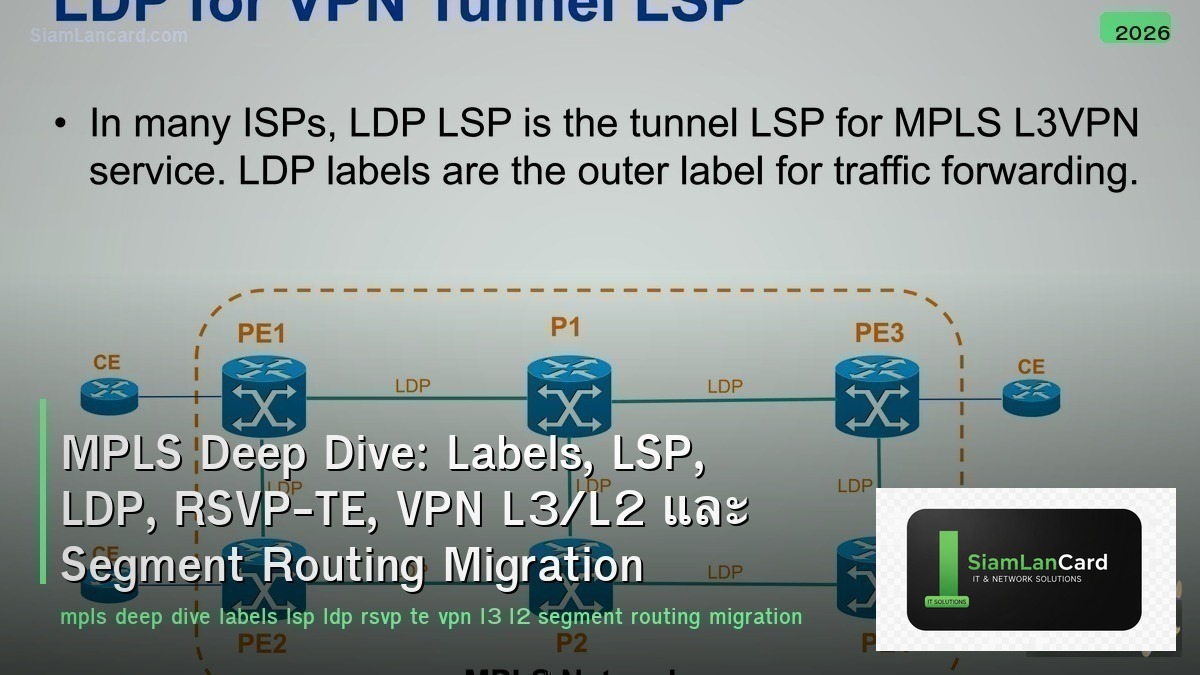
MPLS (Multiprotocol Label Switching) เปลี่ยนการ forward packets จาก IP lookup เป็น label switching ที่เร็วกว่า Labels เป็น short fixed-length identifiers ที่ attach กับ packets, LSP (Label Switched Path) เป็นเส้นทางที่ packets เดินทาง, LDP สร้าง labels อัตโนมัติ, RSVP-TE ให้ traffic engineering capabilities, VPN L3/L2 สร้าง virtual private networks บน MPLS backbone และ Segment Routing เป็น evolution ที่ simplify MPLS
MPLS ยังคงเป็น backbone ของ service provider networks ทั่วโลก: ให้ traffic engineering, fast reroute, VPN services ที่ IP routing ธรรมดาทำไม่ได้ แต่ MPLS มี complexity สูง (LDP + RSVP-TE + BGP + VRF) Segment Routing กำลังเข้ามาแทนที่ด้วย simplicity: ไม่ต้อง LDP, ไม่ต้อง RSVP-TE → ลด protocol overhead อย่างมาก
MPLS Basics
| Concept |
รายละเอียด |
| Label |
20-bit identifier (0-1048575) ใน MPLS header ระหว่าง L2 และ L3 headers |
| Label Stack |
หลาย labels ซ้อนกันได้ (stack) — ใช้สำหรับ VPN, TE, fast reroute |
| Push |
เพิ่ม label (ingress PE) |
| Swap |
เปลี่ยน label (transit P routers) |
| Pop |
ลบ label (egress PE — Penultimate Hop Popping = PHP) |
| FEC |
Forwarding Equivalence Class — group ของ packets ที่ forward เหมือนกัน |
| LFIB |
Label Forwarding Information Base — table ที่ map incoming label → outgoing label + interface |
LSP (Label Switched Path)
| Feature |
รายละเอียด |
| คืออะไร |
Unidirectional path ที่ labeled packets เดินทาง (ingress → transit → egress) |
| Ingress LSR |
Push label → start of LSP (Label Edge Router / PE) |
| Transit LSR |
Swap label → forward along LSP (Provider router / P) |
| Egress LSR |
Pop label → IP lookup → forward to destination (PE) |
| PHP |
Penultimate Hop Popping — second-to-last router pops label → egress ไม่ต้อง label lookup |
| Signaling |
LDP (automatic) หรือ RSVP-TE (engineered) สร้าง LSP |
LDP vs RSVP-TE
| Feature |
LDP |
RSVP-TE |
| Path Selection |
Follows IGP shortest path (no TE) |
Explicit path (constraint-based TE) |
| Bandwidth Reservation |
ไม่มี |
มี (reserve bandwidth per LSP) |
| Fast Reroute |
ไม่มี native (ใช้ IGP convergence) |
มี (Facility backup, One-to-One backup — 50ms failover) |
| Complexity |
ต่ำ (automatic label distribution) |
สูง (explicit paths, bandwidth management) |
| Scalability |
ดี (IGP-based, automatic) |
ต่ำกว่า (per-LSP state on every transit router) |
| Use Case |
Basic MPLS VPN, simple networks |
SP core, traffic engineering, guaranteed SLA |
MPLS VPN L3 (L3VPN)
| Feature |
รายละเอียด |
| คืออะไร |
Virtual routing ที่ให้ customer มี isolated routing table บน shared MPLS backbone |
| VRF |
Virtual Routing and Forwarding — แต่ละ customer มี routing table แยก |
| RD (Route Distinguisher) |
ทำให้ overlapping IP addresses unique ใน BGP (64-bit prefix) |
| RT (Route Target) |
Control ว่า routes ไหนจะ import/export ระหว่าง VRFs |
| MP-BGP |
Multiprotocol BGP carry VPNv4/v6 routes ระหว่าง PEs |
| Label Stack |
2 labels: outer (transport/LSP) + inner (VPN/service) |
| CE-PE |
Customer Edge ↔ Provider Edge: static, OSPF, BGP, EIGRP |
MPLS VPN L2 (L2VPN)
| Type |
Service |
Use Case |
| VPWS (Virtual Private Wire Service) |
Point-to-point L2 circuit (pseudowire) |
Leased line replacement, DC interconnect |
| VPLS (Virtual Private LAN Service) |
Multipoint L2 service (virtual switch) |
Multi-site LAN extension |
| EVPN (Ethernet VPN) |
Modern multipoint L2/L3 service (BGP-based control plane) |
DC fabric, DCI, modern L2VPN (replacing VPLS) |
Segment Routing (SR)
| Feature |
MPLS (Traditional) |
Segment Routing |
| Label Distribution |
LDP + RSVP-TE (separate protocols) |
IGP extensions (IS-IS/OSPF carry SIDs) — no LDP, no RSVP-TE |
| State |
Per-flow state on transit routers (RSVP-TE) |
No per-flow state on transit (source routing — state at ingress only) |
| Traffic Engineering |
RSVP-TE (complex) |
SR-TE with SR Policy (simpler, controller-based) |
| Fast Reroute |
RSVP-TE FRR (facility/one-to-one backup) |
TI-LFA (Topology Independent Loop-Free Alternate) — 50ms, covers all topologies |
| Scalability |
RSVP-TE: poor at scale (per-LSP state) |
Excellent (no per-flow state on transit) |
| Migration |
– |
Co-exist with LDP (interop during migration) |
SR Segment Types
| Segment |
Type |
Use |
| Prefix SID |
Node segment — identifies a node (global) |
Route to specific node (shortest path) |
| Adjacency SID |
Link segment — identifies a specific link (local) |
Steer traffic over specific link (TE) |
| Binding SID |
Policy segment — represents an SR policy |
Simplify complex paths (abstract policy) |
ทิ้งท้าย: MPLS = Foundation of Service Provider Networks
MPLS Deep Dive Labels: 20-bit, push/swap/pop, label stack, FEC, LFIB LSP: unidirectional path (ingress push → transit swap → egress pop/PHP) LDP: automatic (IGP-based), simple | RSVP-TE: TE + bandwidth + FRR, complex L3VPN: VRF + RD + RT + MP-BGP → isolated customer routing on shared backbone L2VPN: VPWS (P2P), VPLS (multipoint), EVPN (modern, BGP-based — replacing VPLS) Segment Routing: no LDP/RSVP-TE, IGP extensions, source routing, TI-LFA, excellent scalability Migration: SR co-exists with LDP → gradual migration → simplify network dramatically
อ่านเพิ่มเติมเกี่ยวกับ VXLAN EVPN Fabric BGP EVPN และ Data Center Interconnect DCI ที่ siamlancard.com หรือจาก icafeforex.com และ siam2r.com