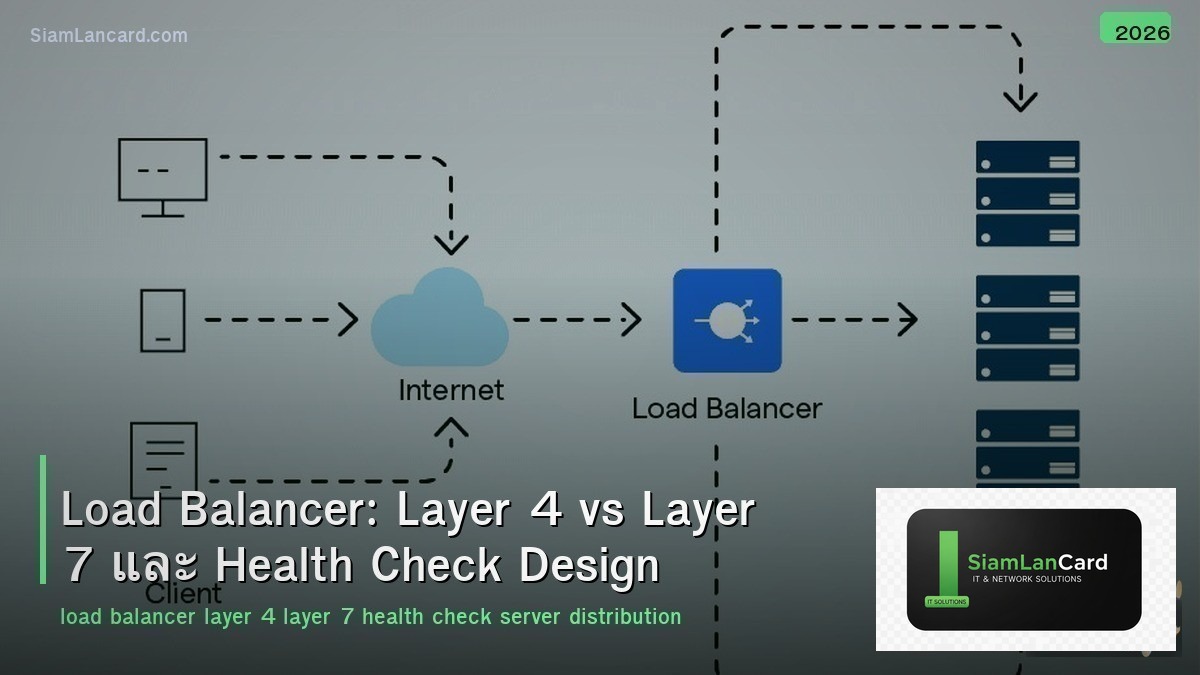
ทุก web application ที่ต้องการ high availability ต้องมี load balancer เพราะถ้า server ตัวเดียว down ทุกอย่างหยุด Load balancer ไม่เพียงกระจาย traffic แต่ยัง health check servers อัตโนมัติ ถ้า server ไหน fail จะหยุดส่ง traffic ไปโดยอัตโนมัติ
Layer 4 vs Layer 7
Feature
Layer 4 (Transport)
Layer 7 (Application)
ทำงานที่
TCP/UDP level (IP + Port)
HTTP/HTTPS level (URL, headers, cookies)
Decision Based On
Source/Dest IP + Port
URL path, hostname, headers, cookies, content
Performance
เร็วกว่า (ไม่ parse content)
ช้ากว่า (parse HTTP)
SSL Termination
ไม่ได้ (pass-through)
ได้ (terminate SSL ที่ LB)
Content Routing
ไม่ได้
Route ตาม URL, host header, etc.
Caching
ไม่ได้
Cache static content ได้
WAF Integration
ไม่ได้
ได้ (inspect HTTP content)
Use Case
TCP services, database, high-performance
Web apps, APIs, microservices
Load Balancing Algorithms
Algorithm
วิธีทำงาน
เหมาะกับ
Round Robin
วนส่งทีละ server
Servers มี capacity เท่ากัน
Weighted Round Robin
วนตาม weight (server แรงกว่าได้มากกว่า)
Servers มี capacity ต่างกัน
Least Connections
ส่งไป server ที่มี active connections น้อยสุด
Long-lived connections (WebSocket, DB)
IP Hash
Hash source IP → same server เสมอ
Session persistence (ไม่มี cookie)
Least Response Time
ส่งไป server ที่ response เร็วสุด
Heterogeneous server performance
Random
สุ่มส่ง
Simple, stateless
Health Check Types
Type
วิธีตรวจ
Depth
TCP Check
เปิด TCP connection → success = healthy
ตื้น (แค่ port เปิด)
HTTP Check
ส่ง GET /health → check HTTP 200 OK
ปานกลาง (app responding)
HTTP Content Check
ส่ง GET /health → check body contains “OK”
ลึก (app logic working)
Custom Script
Run custom script ตรวจ DB, queue, disk
ลึกสุด (full app health)
Health Check Design
Parameter
ค่าแนะนำ
หมายเหตุ
Interval
5-10 วินาที
ถี่เกินไป = load บน servers
Timeout
3-5 วินาที
< interval
Unhealthy Threshold
3 consecutive failures
ป้องกัน flapping
Healthy Threshold
2 consecutive successes
ยืนยันว่า recovered จริง
Health Endpoint
/health หรือ /healthz
Dedicated endpoint ไม่ใช่ homepage
Session Persistence (Sticky Sessions)
Method
วิธีทำงาน
ข้อดี/ข้อเสีย
Source IP
Same IP → same server
ง่าย แต่ NAT ทำให้หลาย users ไป server เดียว
Cookie-based
LB ใส่ cookie → route ตาม cookie
แม่นยำ แต่ต้อง L7 LB
URL Parameter
Route ตาม session ID ใน URL
L7 only, ไม่ secure
Application-level
Shared session store (Redis/DB)
Best: ไม่ต้อง sticky sessions เลย
SSL/TLS Termination
Mode
วิธีทำงาน
ข้อดี/ข้อเสีย
SSL Termination
LB decrypt → ส่ง HTTP ไป backend
ง่าย, LB ทำ SSL offload, backend เบา
SSL Pass-through
LB ส่ง encrypted traffic ตรงไป backend
End-to-end encryption แต่ LB ดู content ไม่ได้
SSL Re-encryption
LB decrypt → re-encrypt → ส่ง HTTPS ไป backend
LB inspect ได้ + encrypted to backend (most secure)
Popular Load Balancers
Solution
Type
จุดเด่น
NGINX
Software (L7)
High performance, reverse proxy, free/plus
HAProxy
Software (L4/L7)
Very high performance, widely used, open-source
AWS ALB
Cloud (L7)
Managed, auto-scale, deep AWS integration
AWS NLB
Cloud (L4)
Ultra-low latency, static IPs, millions of RPS
F5 BIG-IP
Hardware/Virtual (L4/L7)
Enterprise, advanced features, iRules
Citrix ADC
Hardware/Virtual (L4/L7)
Enterprise, application delivery
Traefik
Software (L7)
Cloud-native, auto-discovery, Let’s Encrypt
Envoy
Software (L7)
Service mesh, gRPC, observability
Best Practices
Practice
รายละเอียด
Redundant LBs
Active-passive หรือ active-active LB pair (HA)
Health checks ลึก
HTTP health check ที่ตรวจ app + DB connectivity
SSL termination ที่ LB
Offload SSL ที่ LB → backend ทำงานเบาขึ้น
Stateless backends
ใช้ shared session store → ไม่ต้อง sticky sessions
Connection draining
เมื่อ remove server → drain existing connections ก่อน