Home » IS-IS Routing Protocol: Areas, Levels, TLVs และ Comparison with OSPF
IS-IS Routing Protocol: Areas, Levels, TLVs และ Comparison with OSPF
IS-IS Routing Protocol: Areas, Levels, TLVs และ Comparison with OSPF
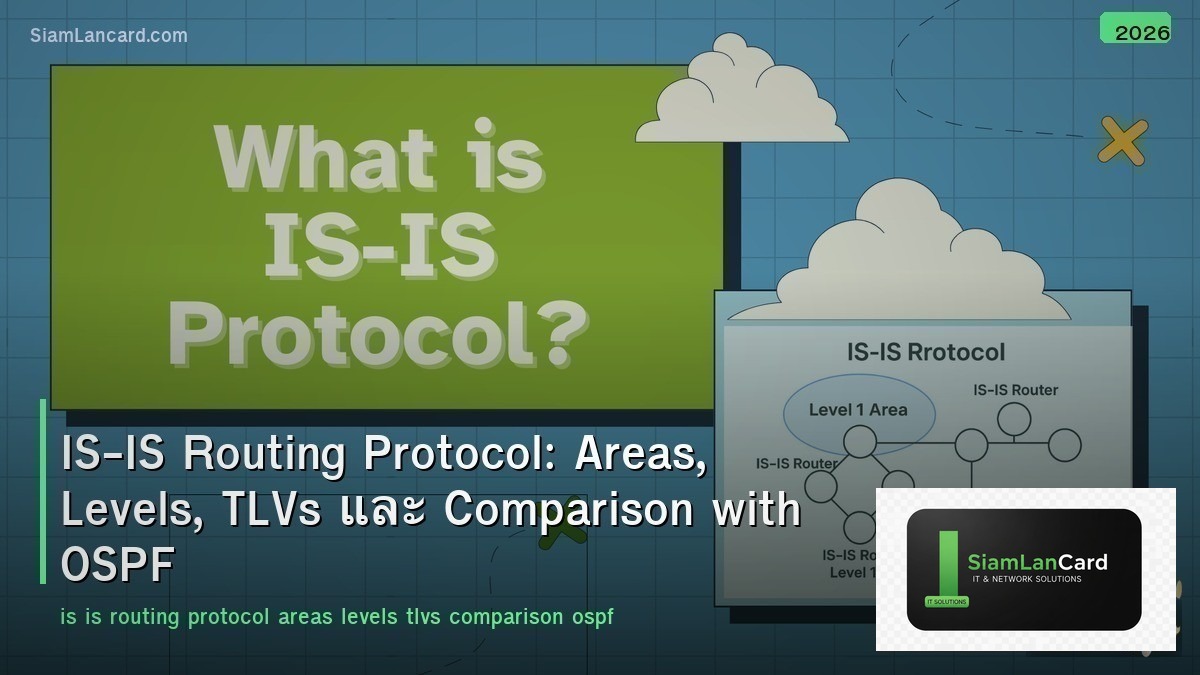
IS-IS (Intermediate System to Intermediate System) เป็น link-state routing protocol ที่ใช้กันอย่างแพร่หลายใน ISP/carrier networks IS-IS ใช้ area design แบบ 2 levels: Level 1 (intra-area) และ Level 2 (inter-area/backbone), TLVs (Type-Length-Value) ทำให้ protocol extensible สามารถเพิ่ม features ใหม่ได้ง่าย และเป็นทางเลือกหลักของ OSPF สำหรับ large-scale networks
OSPF เป็น IGP ที่คนส่วนใหญ่รู้จัก แต่ ISP ระดับ Tier-1 ส่วนใหญ่ใช้ IS-IS เพราะ: (1) IS-IS ทำงานบน Layer 2 (ไม่พึ่ง IP) จึง support IPv4 + IPv6 + Segment Routing ได้โดยธรรมชาติ (2) TLV extensibility ทำให้เพิ่ม features ได้ง่าย (3) Convergence เร็วกว่าใน large-scale networks (4) ไม่มีปัญหา area 0 backbone design
IS-IS vs OSPF
| Feature |
IS-IS |
OSPF |
| Layer |
Layer 2 (CLNS/ISO) |
Layer 3 (IP protocol 89) |
| Encapsulation |
Directly on L2 (no IP needed) |
IP packets (protocol 89) |
| Area Design |
Level 1 + Level 2 (routers on boundaries) |
Area 0 backbone + non-backbone areas |
| Backbone |
Level 2 (contiguous set of L2 routers) |
Area 0 (must be contiguous) |
| Multi-topology |
Native support (MT-IS-IS) |
Limited |
| IPv6 Support |
Native TLV extension |
Separate process (OSPFv3) |
| Extensibility |
TLV-based (easy to add features) |
LSA types (harder to extend) |
| Scalability |
Better for very large networks |
Good but area 0 can bottleneck |
| Segment Routing |
Native TLV support |
Extensions (less mature) |
| Popularity |
ISP/carrier preferred |
Enterprise preferred |
IS-IS Levels
| Level |
Role |
Equivalent |
| Level 1 (L1) |
Intra-area routing (within same area) |
OSPF non-backbone area routing |
| Level 2 (L2) |
Inter-area routing (backbone between areas) |
OSPF area 0 backbone |
| L1/L2 (both) |
Router participates ใน L1 + L2 (ABR equivalent) |
OSPF ABR |
| L1-only |
Intra-area only → default route to L1/L2 for inter-area |
OSPF stub area internal router |
| L2-only |
Backbone only (ไม่ participate ใน L1) |
OSPF backbone-only router |
IS-IS Area Design
| Feature |
รายละเอียด |
| Area = link-based |
IS-IS area กำหนดที่ router (ไม่ใช่ interface เหมือน OSPF) |
| Area boundary |
L1/L2 router = area boundary (links between L1/L2 routers = L2 backbone) |
| No area 0 requirement |
ไม่ต้องมี area 0 — L2 backbone เกิดจาก L2 adjacencies |
| NET (Network Entity Title) |
Router ID format: area.system-id.selector (e.g., 49.0001.1921.6800.1001.00) |
| System ID |
6 bytes unique ID (like OSPF router-id แต่ longer) |
IS-IS PDU Types
| PDU |
Name |
Purpose |
| IIH |
IS-IS Hello |
Discover neighbors + maintain adjacencies |
| LSP |
Link State PDU |
Advertise link-state information (like OSPF LSA) |
| CSNP |
Complete Sequence Number PDU |
Database synchronization (like OSPF DBD) |
| PSNP |
Partial Sequence Number PDU |
Request specific LSPs (like OSPF LSR) |
TLVs (Type-Length-Value)
| TLV |
Type |
Purpose |
| TLV 1 |
Area Addresses |
List of area addresses ของ router |
| TLV 2 |
IS Neighbors (old) |
Advertise neighbors + metrics |
| TLV 22 |
Extended IS Reachability |
Wide metrics + sub-TLVs สำหรับ TE |
| TLV 128/130 |
IP Internal/External Reachability |
IPv4 prefixes (old narrow metrics) |
| TLV 135 |
Extended IP Reachability |
IPv4 prefixes (wide metrics + sub-TLVs) |
| TLV 236 |
IPv6 Reachability |
IPv6 prefixes |
| TLV 242 |
Router Capability |
Segment Routing, SR-MPLS capabilities |
IS-IS Metrics
| Feature |
Narrow Metrics |
Wide Metrics |
| Interface Metric |
6 bits (0-63) |
24 bits (0-16,777,215) |
| Path Metric |
10 bits (0-1023) |
32 bits (0-4,294,967,295) |
| Use Case |
Legacy (very limited) |
Modern (always use wide metrics) |
| TE Support |
ไม่มี |
มี (sub-TLVs in TLV 22) |
IS-IS + Segment Routing
| Feature |
รายละเอียด |
| SR-MPLS |
IS-IS distribute Prefix-SID + Adjacency-SID ผ่าน TLV extensions |
| SRv6 |
IS-IS distribute SRv6 SIDs (TLV extensions สำหรับ IPv6 SR) |
| TI-LFA |
Topology-Independent Loop-Free Alternate (sub-50ms FRR) |
| Flex-Algo |
Multiple routing algorithms ใน IS-IS domain เดียว (different constraints) |
| Advantage |
IS-IS + SR = modern SP backbone (replace MPLS LDP/RSVP-TE) |
ทิ้งท้าย: IS-IS = ISP’s Choice for Scalable Routing
IS-IS L2 protocol (ไม่พึ่ง IP), TLV extensibility, scalable for large networks Levels: L1 (intra-area) + L2 (backbone) — no area 0 requirement TLVs: extensible design → native support for IPv6, SR-MPLS, SRv6 Wide metrics: 24-bit interface, 32-bit path (always use wide) SR integration: Prefix-SID, Adj-SID, TI-LFA, Flex-Algo ISP preferred: Tier-1 ISPs mostly run IS-IS (not OSPF) Enterprise: OSPF ยังเป็นที่นิยม (simpler, more familiar)
อ่านเพิ่มเติมเกี่ยวกับ OSPF Advanced Areas LSA และ BGP Communities ที่ siamlancard.com หรือจาก icafeforex.com และ siam2r.com