Home » EVPN-VXLAN: Data Center Fabric, Type-2/5 Routes, ARP Suppression และ Multi-Site
EVPN-VXLAN: Data Center Fabric, Type-2/5 Routes, ARP Suppression และ Multi-Site
EVPN-VXLAN: Data Center Fabric, Type-2/5 Routes, ARP Suppression และ Multi-Site
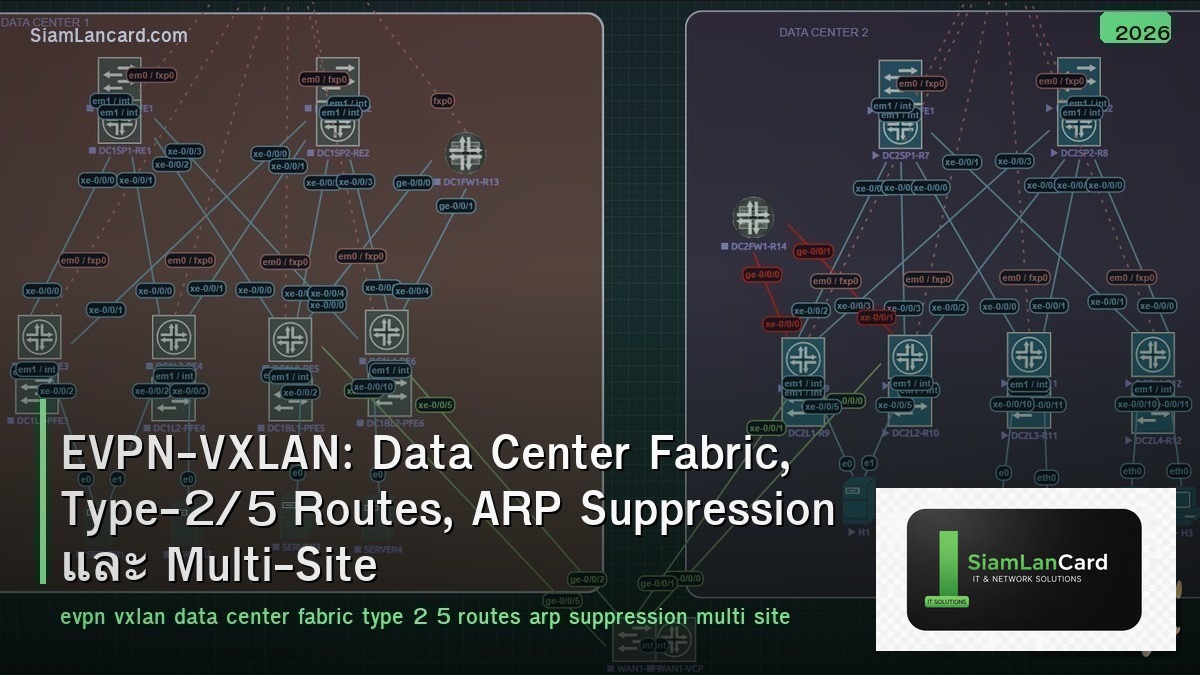
EVPN-VXLAN เป็น modern data center fabric technology ที่รวม control plane (EVPN/BGP) กับ data plane (VXLAN) EVPN ใช้ BGP เป็น control plane สำหรับ MAC/IP learning + distribution, VXLAN encapsulate L2 frames ใน UDP/IP สำหรับ overlay networking, Type-2 Routes advertise MAC+IP bindings, Type-5 Routes advertise IP prefixes สำหรับ inter-VXLAN routing, ARP Suppression ลด broadcast traffic และ Multi-Site extend fabric ข้าม data centers
Traditional data center networking ใช้ Spanning Tree + VLANs ซึ่งมีข้อจำกัด: STP blocks 50% ของ links (waste bandwidth), VLAN limit 4,096, broadcast storms, MAC table overflow EVPN-VXLAN แก้ทุกปัญหา: ECMP load balancing (use all links), 16M+ VNIs, control-plane MAC learning (no flooding), scalable multi-tenancy
VXLAN Basics
| Feature |
รายละเอียด |
| คืออะไร |
Virtual Extensible LAN — encapsulate L2 Ethernet frames ใน UDP/IP (overlay) |
| VNI (VXLAN Network Identifier) |
24-bit identifier → 16,777,216 segments (vs 4,096 VLANs) |
| VTEP (VXLAN Tunnel Endpoint) |
Device ที่ encapsulate/decapsulate VXLAN (switch, hypervisor, router) |
| Encapsulation |
Original Ethernet frame + VXLAN header + UDP (port 4789) + Outer IP + Outer Ethernet |
| Overhead |
50 bytes (need MTU ≥ 1,550 บน underlay — recommended 9,216 jumbo frames) |
| Underlay |
IP network ที่ carry VXLAN traffic (L3 routed — OSPF, BGP, IS-IS) |
| Overlay |
Virtual L2/L3 networks บน VXLAN (tenants, VRFs) |
EVPN (Ethernet VPN)
| Feature |
รายละเอียด |
| คืออะไร |
BGP address family (AFI 25, SAFI 70) สำหรับ distribute MAC + IP information |
| Control Plane |
BGP advertise MAC/IP → VTEPs learn remote MAC/IP จาก BGP (ไม่ต้อง flood) |
| MP-BGP |
ใช้ Multi-Protocol BGP (EVPN address family) ระหว่าง VTEPs |
| Route Distinguisher (RD) |
ทำให้ routes จาก different tenants unique ใน BGP table |
| Route Target (RT) |
Control ว่า routes ถูก import/export ไป VRF/tenant ไหน |
EVPN Route Types
| Type |
Name |
Purpose |
| Type 1 |
Ethernet Auto-Discovery |
Multi-homing: advertise ESI (Ethernet Segment ID) สำหรับ redundancy |
| Type 2 |
MAC/IP Advertisement |
Advertise MAC address + optional IP address (host routes) |
| Type 3 |
Inclusive Multicast |
Advertise VTEP participation in VNI (BUM traffic handling) |
| Type 4 |
Ethernet Segment |
DF (Designated Forwarder) election สำหรับ multi-homing |
| Type 5 |
IP Prefix |
Advertise IP prefixes (inter-VNI routing, external prefixes) |
Type-2 Route (MAC/IP)
| Field |
รายละเอียด |
| MAC Address |
Host MAC (e.g., 00:11:22:33:44:55) |
| IP Address |
Host IP (optional — MAC-only or MAC+IP) |
| VNI (L2 VNI) |
VXLAN segment ที่ host อยู่ |
| VTEP IP |
VTEP ที่ host connected (next-hop ใน BGP) |
| Use Case |
Remote VTEP learns MAC+IP จาก BGP → สร้าง VXLAN tunnel → forward traffic |
Type-5 Route (IP Prefix)
| Field |
รายละเอียด |
| IP Prefix |
Network prefix (e.g., 10.1.0.0/24) |
| VRF |
L3 VNI / tenant VRF ที่ prefix อยู่ |
| Gateway IP |
Distributed anycast gateway IP |
| Use Case |
Inter-VXLAN routing: route traffic ระหว่าง different VNIs/subnets ภายใน fabric |
| External |
Advertise external routes (from firewall, WAN) เข้า fabric |
ARP Suppression
| Feature |
รายละเอียด |
| Problem |
ARP requests = broadcast → flood ทั้ง VXLAN segment → waste bandwidth |
| Solution |
VTEP ตอบ ARP requests locally จาก MAC/IP table (learned from EVPN Type-2) |
| How |
Host sends ARP → local VTEP checks BGP-learned MAC/IP → replies directly (no flood) |
| Benefit |
ลด BUM (Broadcast, Unknown Unicast, Multicast) traffic 90%+ ใน fabric |
Distributed Anycast Gateway
| Feature |
รายละเอียด |
| คืออะไร |
ทุก leaf switch เป็น gateway สำหรับ connected hosts (same IP + same MAC) |
| Anycast IP |
ทุก leaf ใช้ gateway IP เดียวกัน (e.g., 10.1.1.1) สำหรับแต่ละ subnet |
| Anycast MAC |
ทุก leaf ใช้ virtual MAC เดียวกัน (e.g., 00:00:5e:00:01:01) |
| Benefit |
Host route ที่ local leaf ทันที (ไม่ต้อง traverse fabric ไป centralized gateway) |
| VM Mobility |
VM ย้าย leaf → gateway IP/MAC เหมือนเดิม → seamless (no ARP refresh needed) |
Multi-Site EVPN
| Feature |
รายละเอียด |
| คืออะไร |
Extend EVPN-VXLAN fabric ข้าม multiple data centers (sites) |
| Border Leaf/Gateway |
Border device ที่ connect sites → re-originate EVPN routes ระหว่าง sites |
| DCI (Data Center Interconnect) |
WAN link ระหว่าง sites (dark fiber, DWDM, MPLS, internet) |
| Stretched VNI |
Same VNI ข้าม sites → L2 extension (VM mobility ข้าม DC) |
| Asymmetric vs Symmetric |
Asymmetric: route on ingress, bridge on egress | Symmetric: route on both (more scalable) |
Fabric Design
| Design |
Topology |
Use Case |
| 2-Tier (Spine-Leaf) |
Spine switches + Leaf switches (CLOS topology) |
Standard DC fabric (most common) |
| 3-Tier (Super Spine) |
Super Spine + Spine + Leaf |
Very large DC (multiple pods) |
| Collapsed Spine |
Spine + Leaf combined (small DC) |
Small DC / remote sites |
| Multi-Pod |
Multiple spine-leaf pods connected via super spines |
Scale beyond single pod |
| Multi-Site |
Multiple DCs connected via DCI |
DR, workload mobility, multi-DC |
ทิ้งท้าย: EVPN-VXLAN = Modern Data Center Networking Standard
EVPN-VXLAN VXLAN: L2 overlay over L3 underlay (UDP encapsulation, VNI 24-bit = 16M segments) EVPN: BGP control plane for MAC/IP distribution (no flooding, control-plane learning) Type-2: MAC/IP advertisement (host routes) | Type-5: IP prefix (inter-VNI routing) ARP Suppression: local VTEP answers ARP from BGP-learned data (90%+ less BUM traffic) Anycast Gateway: distributed L3 gateway on every leaf (same IP/MAC, optimal routing) Multi-Site: extend fabric across DCs via border gateways + DCI Fabric: spine-leaf CLOS topology, ECMP, no STP, scalable multi-tenancy
อ่านเพิ่มเติมเกี่ยวกับ Network Design Patterns Spine-Leaf และ BGP Advanced Route Reflectors ที่ siamlancard.com หรือจาก icafeforex.com และ siam2r.com