Home » EVPN-VXLAN Data Center Fabric: Spine-Leaf, Type-2/5 Routes และ Multi-tenancy
EVPN-VXLAN Data Center Fabric: Spine-Leaf, Type-2/5 Routes และ Multi-tenancy
EVPN-VXLAN Data Center Fabric: Spine-Leaf, Type-2/5 Routes และ Multi-tenancy
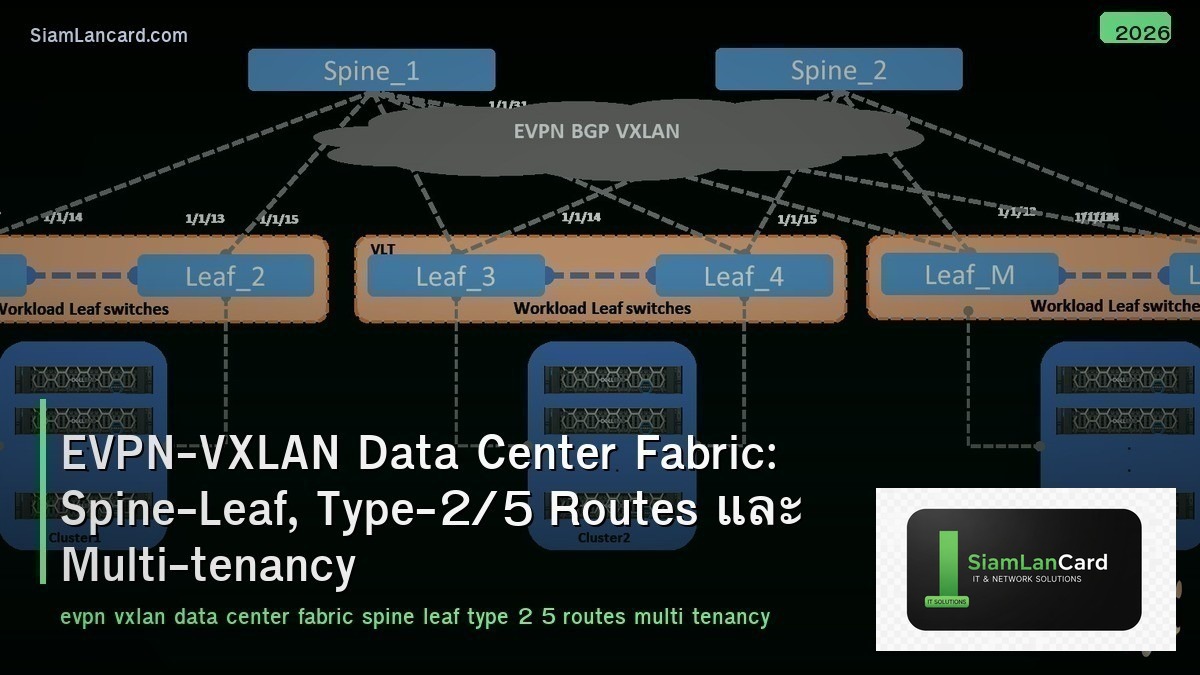
EVPN-VXLAN เป็น modern data center fabric technology ที่รวม EVPN (Ethernet VPN) control plane กับ VXLAN (Virtual Extensible LAN) data plane Spine-Leaf topology ให้ predictable latency และ scalability, EVPN Type-2 routes สำหรับ MAC/IP advertisement, Type-5 routes สำหรับ IP prefix routing และ Multi-tenancy แยก tenants ด้วย VRF + VNI
Traditional data center ใช้ STP + VLAN ที่ ไม่ scale เกิน 4,094 VLANs และมี convergence ช้า EVPN-VXLAN แก้ทุกปัญหา: 16M+ segments (24-bit VNI), active-active multi-homing (ไม่มี blocked links), distributed anycast gateway (ไม่ต้องใช้ FHRP), optimal east-west traffic (spine-leaf ทุก path active)
Spine-Leaf Architecture
| Component |
Role |
รายละเอียด |
| Leaf Switch (TOR) |
Access layer |
Connect servers, storage → every leaf connects to every spine |
| Spine Switch |
Aggregation/Core |
Interconnect all leafs → no leaf-to-leaf direct links |
| VTEP (VXLAN Tunnel Endpoint) |
Encap/Decap |
Leaf switches ทำหน้าที่ VTEP (encapsulate frames in VXLAN) |
| Border Leaf |
External connectivity |
Connect to WAN, internet, other DCs (DCI) |
VXLAN Fundamentals
| Feature |
รายละเอียด |
| VNI (VXLAN Network Identifier) |
24-bit segment ID (16M+ segments vs VLAN 4,094) |
| Encapsulation |
Original L2 frame → VXLAN header → UDP → outer IP → outer L2 |
| UDP Port |
4789 (destination port) |
| VTEP |
Tunnel endpoint ที่ encap/decap VXLAN packets |
| L2 VNI |
Map to VLAN → extend L2 domain across fabric |
| L3 VNI |
Map to VRF → inter-VLAN routing across fabric |
| Anycast Gateway |
Same gateway IP + MAC บนทุก leaf → distributed routing (no FHRP) |
EVPN Route Types
| Type |
Name |
Purpose |
| Type-1 |
Ethernet Auto-Discovery |
Multi-homing: fast convergence + aliasing + mass withdrawal |
| Type-2 |
MAC/IP Advertisement |
Advertise MAC address + optional IP (host routes) |
| Type-3 |
Inclusive Multicast |
BUM (Broadcast, Unknown unicast, Multicast) handling |
| Type-4 |
Ethernet Segment |
Designated Forwarder election สำหรับ multi-homing |
| Type-5 |
IP Prefix |
Advertise IP prefixes (inter-subnet routing, external routes) |
Type-2 vs Type-5
| Feature |
Type-2 (MAC/IP) |
Type-5 (IP Prefix) |
| What |
Host MAC + IP (learned from data plane) |
IP subnet/prefix (from routing or static) |
| Scope |
/32 host routes (specific host) |
Any prefix length (/8, /16, /24, etc.) |
| Source |
ARP/ND learning on leaf |
Connected, static, redistributed routes |
| Use Case |
Intra-fabric host communication |
External routing, inter-DC, summarization |
| VNI |
L2 VNI (per VLAN) |
L3 VNI (per VRF) |
Multi-tenancy
| Feature |
รายละเอียด |
| VRF (Virtual Routing and Forwarding) |
แยก routing table per tenant |
| L3 VNI |
แต่ละ VRF มี L3 VNI สำหรับ inter-subnet routing across fabric |
| Route Target (RT) |
BGP extended community ที่กำหนดว่า route ไปอยู่ VRF ไหน |
| Route Distinguisher (RD) |
ทำให้ overlapping prefixes unique ใน BGP (per VRF per leaf) |
| Isolation |
Tenant A ไม่เห็น Tenant B traffic (full isolation) |
| Inter-tenant |
Route leaking ระหว่าง VRFs (controlled, policy-based) |
Multi-homing (ESI)
| Feature |
รายละเอียด |
| ESI (Ethernet Segment Identifier) |
Identifier สำหรับ multi-homed host/switch |
| Active-Active |
Host connects to 2 leafs → both forward traffic (LACP) |
| DF Election |
1 leaf per VLAN elected as Designated Forwarder (BUM traffic) |
| Aliasing |
Remote leaf knows both paths → load balance across both |
| Mass Withdrawal |
Leaf fails → single Type-1 withdrawal → all MACs withdrawn (fast) |
| Benefit |
No STP blocking, active-active forwarding, fast failover |
Design Best Practices
| Practice |
รายละเอียด |
| eBGP underlay |
eBGP ระหว่าง leaf-spine (unique ASN per leaf หรือ per tier) |
| iBGP EVPN overlay |
iBGP with spine as route reflectors สำหรับ EVPN routes |
| Anycast gateway |
Same IP + virtual MAC ทุก leaf → distributed first-hop routing |
| Symmetric IRB |
Inter-subnet routing: route on ingress leaf + route on egress leaf (L3 VNI) |
| VXLAN MTU |
Underlay MTU ≥ 9216 (jumbo frames) เพื่อรองรับ VXLAN overhead (50 bytes) |
| BUM handling |
Ingress replication (unicast) หรือ multicast underlay |
| ARP suppression |
Leaf ตอบ ARP locally (ลด BUM flooding) |
ทิ้งท้าย: EVPN-VXLAN = Modern Data Center Fabric Standard
EVPN-VXLAN Spine-Leaf: predictable latency, all paths active, scalable VXLAN: 16M segments (VNI), L2 extension across IP underlay EVPN: Type-2 (MAC/IP hosts), Type-5 (IP prefixes), Type-1 (multi-homing) Multi-tenancy: VRF + L3 VNI + RT/RD (full tenant isolation) Multi-homing: ESI + active-active + aliasing + mass withdrawal (no STP) Design: eBGP underlay + iBGP EVPN overlay + anycast gateway + symmetric IRB
อ่านเพิ่มเติมเกี่ยวกับ Network Redundancy HSRP VRRP GLBP และ STP RSTP MSTP Best Practices ที่ siamlancard.com หรือจาก icafeforex.com และ siam2r.com