Home » EVPN-VXLAN: BGP EVPN, VXLAN Overlay, Type-2/5 Routes, Distributed Gateway และ Data Center Fabric
EVPN-VXLAN: BGP EVPN, VXLAN Overlay, Type-2/5 Routes, Distributed Gateway และ Data Center Fabric
EVPN-VXLAN: BGP EVPN, VXLAN Overlay, Type-2/5 Routes, Distributed Gateway และ Data Center Fabric
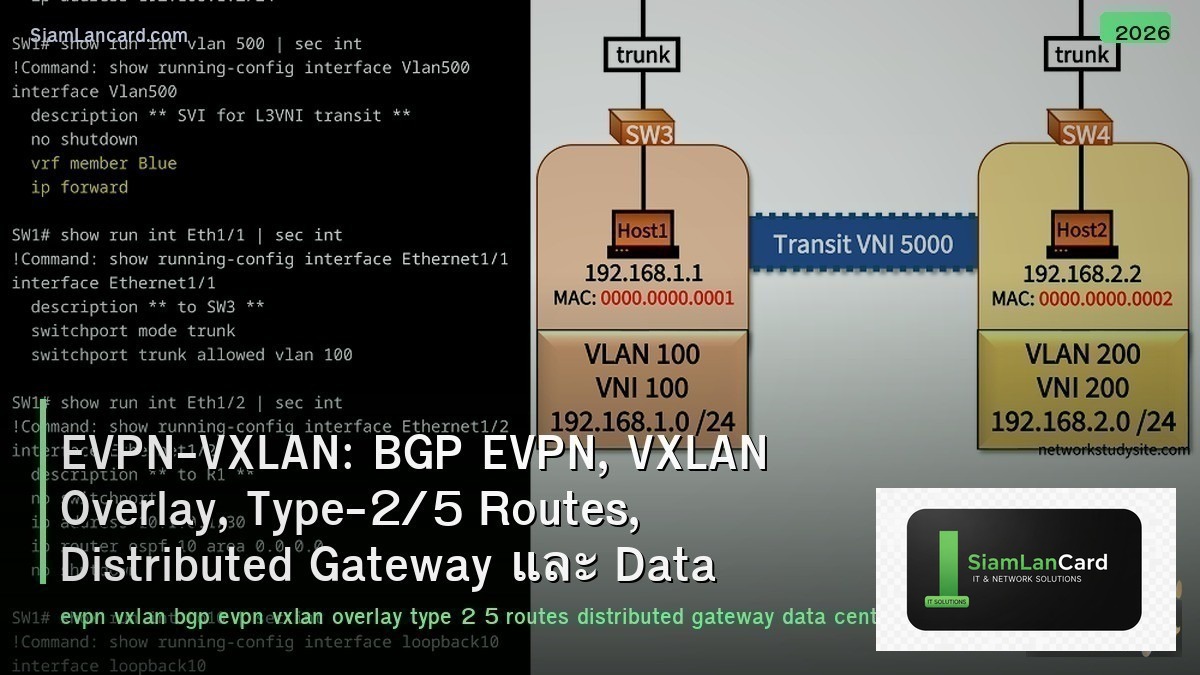
EVPN-VXLAN เป็นเทคโนโลยีหลักของ modern data center fabric BGP EVPN เป็น control plane ที่แจกจ่าย MAC/IP information, VXLAN เป็น data plane overlay ที่ขยาย L2 domain ข้าม L3 network, Type-2 Routes สำหรับ MAC/IP advertisement, Type-5 Routes สำหรับ IP prefix routing, Distributed Gateway กระจาย gateway ไปทุก leaf switch และ Data Center Fabric รวมทุกอย่างเป็น spine-leaf architecture
EVPN-VXLAN เป็น มาตรฐานที่ทุก data center vendor ใช้ (Cisco ACI, Arista, Juniper, Nokia, Dell): แทนที่ legacy STP + VLAN trunking ด้วย VXLAN overlay → ไม่มี STP loops, L2 extension ข้าม L3 ได้, scale ถึง 16 million segments (vs 4,096 VLANs) BGP EVPN เป็น single control plane สำหรับทั้ง L2 และ L3 → ลดความซับซ้อน, MAC learning ผ่าน control plane (ไม่ใช่ flood-and-learn)
VXLAN Basics
| Feature |
Detail |
| What |
Virtual Extensible LAN — L2 overlay over L3 underlay (MAC-in-UDP encapsulation) |
| VNI |
VXLAN Network Identifier — 24-bit = 16 million segments (vs VLAN 12-bit = 4,096) |
| VTEP |
VXLAN Tunnel Endpoint — device that encapsulates/decapsulates VXLAN (leaf switches) |
| Encapsulation |
Original L2 frame → VXLAN header (VNI) → UDP (port 4789) → outer IP → outer L2 |
| Overhead |
50-54 bytes additional header → MTU must be 1550+ on underlay (recommend 9214 jumbo) |
| Underlay |
Any L3 network with IP reachability between VTEPs — typically OSPF/IS-IS/BGP |
BGP EVPN Route Types
| Type |
Name |
Function |
| Type-1 |
Ethernet Auto-Discovery |
Multi-homing: advertise Ethernet Segment (ESI) for all-active multi-homing, fast convergence |
| Type-2 |
MAC/IP Advertisement |
Advertise MAC address + optional IP → replace flood-and-learn with control-plane learning |
| Type-3 |
Inclusive Multicast Ethernet Tag |
BUM traffic handling: ingress replication list or multicast group for each VNI |
| Type-4 |
Ethernet Segment |
DF (Designated Forwarder) election for multi-homing — prevent duplicate frames |
| Type-5 |
IP Prefix Route |
Advertise IP prefixes for inter-VNI routing (L3 VPN) — external route leaking |
Distributed Anycast Gateway
| Feature |
Detail |
| What |
Same gateway IP + same virtual MAC on every leaf switch — traffic routes locally |
| Benefit |
No hairpinning to centralized gateway → optimal traffic path, reduced latency |
| MAC |
All leafs share same virtual MAC for gateway → host ARP sees same MAC everywhere |
| Mobility |
VM moves to different leaf → same gateway available locally → seamless migration |
| Routing |
Inter-VXLAN routing happens at first-hop leaf (not at spine) → distributed routing |
Spine-Leaf Fabric Design
| Layer |
Role |
Protocol |
| Spine |
Forwarding/transit only — no hosts connected, L3 only |
eBGP underlay + eBGP EVPN overlay (or OSPF underlay) |
| Leaf |
VTEP — hosts/servers connect here, VXLAN encap/decap, distributed gateway |
BGP EVPN: advertise Type-2 (MAC/IP) and Type-5 (prefixes) |
| Border Leaf |
Connect fabric to external networks (WAN, internet, other DCs) |
eBGP to external, Type-5 for external prefix injection |
| Underlay |
IP connectivity between VTEPs (loopbacks) |
eBGP (recommended) or OSPF/IS-IS — simple L3 reachability |
| Overlay |
VXLAN tunnels + BGP EVPN control plane |
iBGP EVPN with route reflector (spines) or eBGP EVPN |
EVPN Multi-Homing
| Feature |
Detail |
| ESI (Ethernet Segment ID) |
Unique identifier for multi-homed link — same ESI on both leaf switches |
| All-Active |
Both leafs forward traffic simultaneously → load balancing + redundancy |
| DF Election |
Type-4 route elects Designated Forwarder per VLAN → prevents duplicate BUM frames |
| Fast Convergence |
Type-1 route: mass withdraw on failure → all remote VTEPs update instantly |
| vs MLAG/vPC |
EVPN multi-homing = standard-based (any vendor) vs MLAG = proprietary per vendor |
ทิ้งท้าย: EVPN-VXLAN = The Standard for Modern Data Centers
EVPN-VXLAN VXLAN: L2 overlay over L3 — MAC-in-UDP, VNI (16M segments), VTEP encap/decap, 50-byte overhead → jumbo MTU BGP EVPN Routes: Type-2 (MAC/IP learning), Type-3 (BUM handling), Type-5 (IP prefix/L3 VPN), Type-1/4 (multi-homing) Distributed Gateway: same IP+MAC on every leaf → local routing, no hairpin, seamless VM mobility Fabric: spine (transit) + leaf (VTEP+gateway) + border leaf (external) — eBGP underlay + eBGP/iBGP EVPN overlay Multi-Homing: ESI-based, all-active, DF election, fast convergence — standard-based replacement for MLAG Key: EVPN-VXLAN replaces STP+VLAN with scalable, standard-based fabric — every major DC vendor supports it
อ่านเพิ่มเติมเกี่ยวกับ Data Center Networking Spine-Leaf Fabric Architecture และ MPLS Deep Dive Label Switching LSP LDP RSVP-TE ที่ siamlancard.com หรือจาก icafeforex.com และ siam2r.com