Home » Data Center Networking: Spine-Leaf, VXLAN Fabric, ECMP, Overlay/Underlay และ DC Interconnect
Data Center Networking: Spine-Leaf, VXLAN Fabric, ECMP, Overlay/Underlay และ DC Interconnect
Data Center Networking: Spine-Leaf, VXLAN Fabric, ECMP, Overlay/Underlay และ DC Interconnect
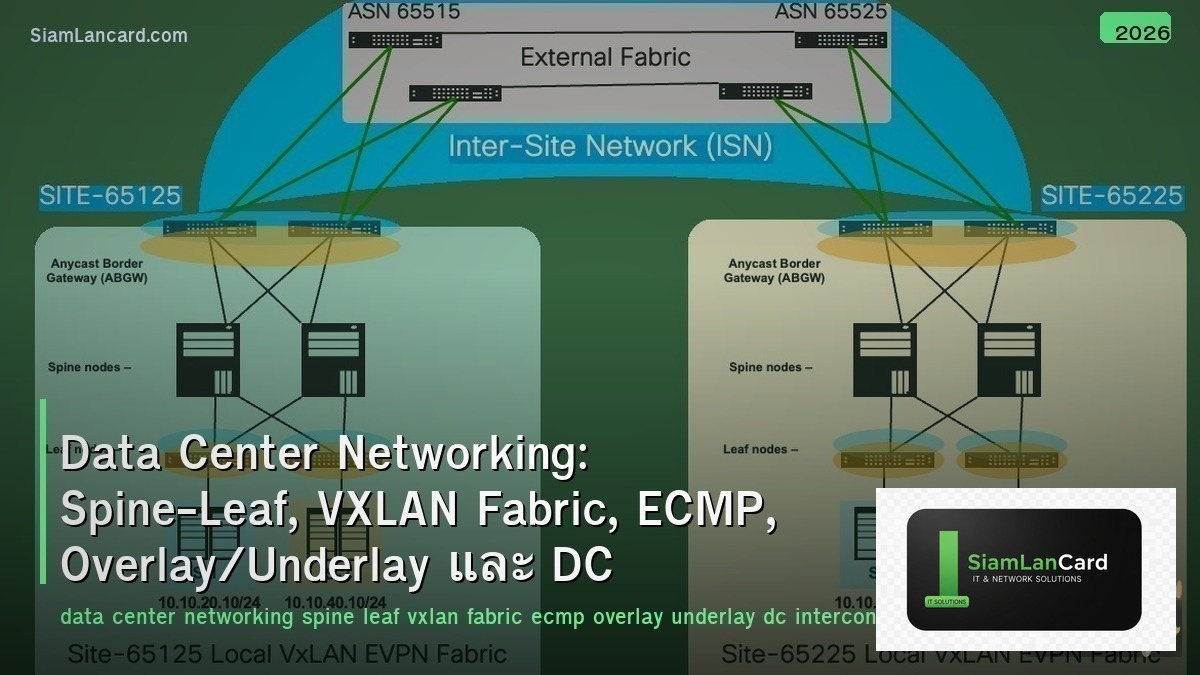
Data Center Networking ออกแบบเพื่อ high bandwidth, low latency และ scalability Spine-Leaf topology ให้ consistent latency ทุก path, VXLAN Fabric สร้าง overlay network สำหรับ multi-tenancy, ECMP กระจาย traffic ข้ามหลาย paths, Overlay/Underlay แยก logical network จาก physical และ DC Interconnect เชื่อมต่อ data centers เข้าด้วยกัน
Traditional 3-tier architecture (Core-Distribution-Access) ไม่เหมาะกับ modern data centers: East-West traffic (server-to-server) มากกว่า North-South (client-to-server) 80:20, STP blocks redundant links (waste bandwidth), latency ไม่ consistent (depends on path), ไม่ scale ง่าย Spine-Leaf + VXLAN แก้ทุกปัญหา: ทุก path active (ECMP), consistent 2-hop latency, overlay decouples logical from physical
Spine-Leaf Topology
| Feature |
รายละเอียด |
| Structure |
Every leaf connects to every spine — 2-tier folded Clos topology |
| Leaf (ToR) |
Top-of-Rack switches — connect servers, storage, firewalls |
| Spine |
Aggregation layer — connect all leaves, no devices directly attached |
| Latency |
Consistent: any server reaches any other server ใน exactly 2 hops (leaf → spine → leaf) |
| No STP |
All links active — L3 routing (BGP/OSPF) + ECMP instead of STP |
| Scale |
Add more spines for bandwidth, more leaves for ports — horizontal scaling |
| Oversubscription |
Spine bandwidth = leaf uplinks × number of leaves → design for 3:1 to 1:1 ratio |
VXLAN (Virtual Extensible LAN)
| Feature |
รายละเอียด |
| คืออะไร |
Overlay protocol: encapsulate L2 frames in UDP/IP → extend L2 over L3 underlay |
| VNI |
VXLAN Network Identifier (24-bit) → 16 million segments (vs VLAN 4096) |
| VTEP |
VXLAN Tunnel Endpoint — leaf switch ที่ encap/decap VXLAN |
| Encapsulation |
Original frame + VXLAN header (8B) + UDP (8B) + outer IP (20B) + outer Ethernet (14B) = 50B overhead |
| MTU |
ต้อง increase MTU to 9000+ (jumbo frames) บน underlay เพื่อรองรับ overhead |
| UDP Port |
Destination port 4789 (IANA assigned) |
| Control Plane |
Multicast (flood-and-learn), ingress replication, หรือ BGP EVPN (preferred) |
BGP EVPN (Control Plane for VXLAN)
| Feature |
รายละเอียด |
| คืออะไร |
BGP address family ที่ distribute MAC/IP reachability สำหรับ VXLAN fabric |
| Route Types |
Type 2 (MAC/IP), Type 3 (multicast), Type 5 (IP prefix) — most important types |
| Advantage |
No flooding: learn MAC/IP via BGP → directed forwarding (unicast only) |
| ARP Suppression |
VTEP answers ARP locally (from BGP-learned info) → reduce ARP flooding |
| Multi-Tenancy |
VRF per tenant → L3 VNI for inter-VXLAN routing → complete isolation |
| Symmetric IRB |
Integrated Routing and Bridging: route at ingress AND egress VTEP → optimal path |
ECMP (Equal-Cost Multi-Path)
| Feature |
รายละเอียด |
| คืออะไร |
Load balance traffic across multiple equal-cost paths → use all spine links |
| Hash |
5-tuple hash (src IP, dst IP, src port, dst port, protocol) → per-flow load balancing |
| Paths |
Spine-leaf: each leaf has N paths (one per spine) → N-way ECMP |
| Polarization |
Problem: same hash at leaf and spine → traffic uses same path → uneven distribution |
| Fix Polarization |
Different hash seeds at each layer, unique router-id, entropy in VXLAN UDP source port |
| BGP Multipath |
maximum-paths [N] — allow multiple BGP next-hops ใน routing table |
Overlay vs Underlay
| Feature |
Underlay |
Overlay |
| What |
Physical network (IP routing between VTEPs) |
Virtual network (VXLAN tunnels carrying tenant traffic) |
| Protocol |
OSPF, BGP, IS-IS (L3 routing) |
VXLAN + BGP EVPN (L2/L3 overlay) |
| Addressing |
Loopback IPs for VTEPs, P2P links |
Tenant IPs, MAC addresses, VNIs |
| Design |
Simple: L3 everywhere, ECMP, no STP |
Complex: VNI mapping, EVPN routes, IRB |
| Change |
Rarely changes (stable infrastructure) |
Frequently changes (tenant adds/moves) |
DC Interconnect (DCI)
| Method |
How |
Use Case |
| VXLAN over WAN |
Extend VXLAN fabric across DCI link → same VNI in both DCs |
VM mobility, disaster recovery |
| EVPN Multi-Site |
BGP EVPN between DC border leaves → selective route exchange |
Large-scale multi-DC (Cisco, Arista) |
| OTV (Overlay Transport Virtualization) |
Cisco: extend L2 over L3 WAN without STP |
Legacy DCI (being replaced by EVPN) |
| MPLS/VPLS |
Service provider L2VPN between DCs |
Carrier-managed DCI |
| SD-WAN |
Overlay WAN connecting DC sites |
Branch-to-DC and DC-to-DC connectivity |
ทิ้งท้าย: Modern DC = Spine-Leaf + VXLAN EVPN
Data Center Networking Spine-Leaf: 2-tier Clos, every leaf to every spine, consistent 2-hop latency, no STP, ECMP VXLAN: L2 over L3 overlay, VNI (16M segments), VTEP (encap/decap), 50B overhead, MTU 9000+ BGP EVPN: control plane for VXLAN, MAC/IP learning via BGP, ARP suppression, symmetric IRB, multi-tenancy ECMP: all paths active, 5-tuple hash, fix polarization with different seeds/entropy Overlay/Underlay: underlay = simple L3 (OSPF/BGP), overlay = complex tenant networks (VXLAN/EVPN) DCI: EVPN Multi-Site (preferred), VXLAN over WAN, OTV (legacy), MPLS/VPLS (carrier) Key: spine-leaf + VXLAN EVPN = standard modern DC architecture — all links active, scalable, multi-tenant
อ่านเพิ่มเติมเกี่ยวกับ VXLAN EVPN Fabric BGP EVPN Data Center และ Network Design Patterns Spine-Leaf Campus ที่ siamlancard.com หรือจาก icafeforex.com และ siam2r.com