Cloud Networking: VPC, Subnet, Security Group, Transit Gateway, PrivateLink และ Multi-Cloud

Cloud Networking: VPC, Subnet, Security Group, Transit Gateway, PrivateLink และ Multi-Cloud

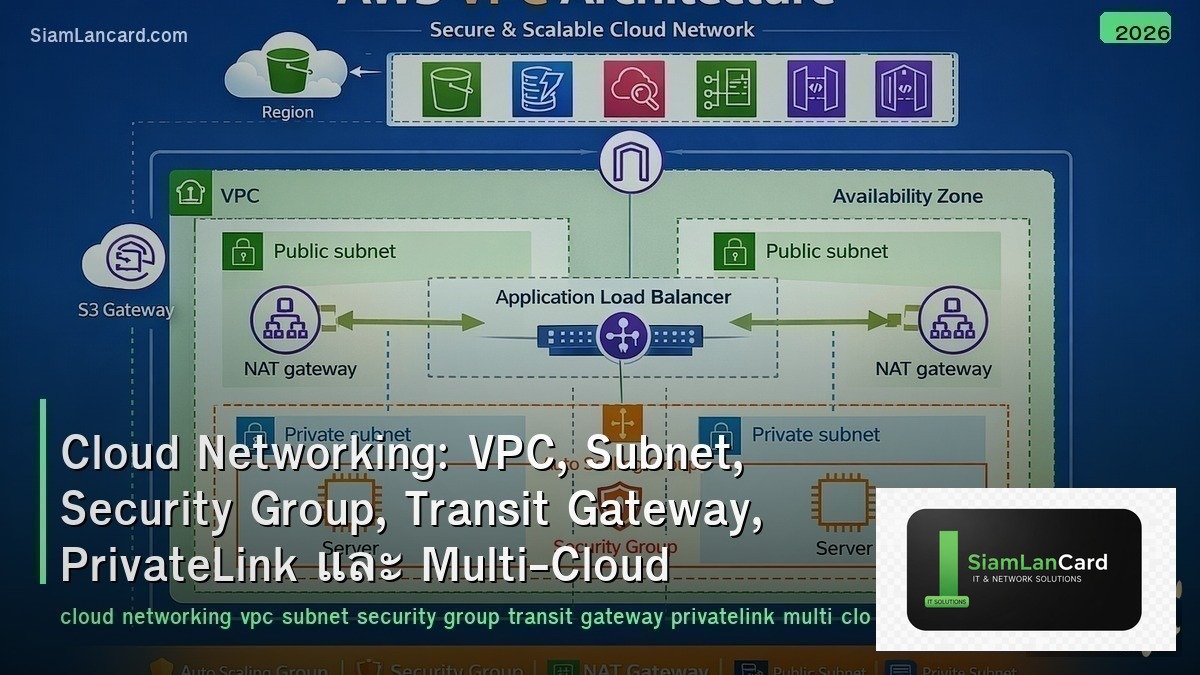
Cloud Networking เป็นพื้นฐานของ cloud infrastructure VPC (Virtual Private Cloud) สร้าง isolated network ใน cloud, Subnet แบ่ง VPC เป็นส่วนย่อย, Security Group ทำหน้าที่เป็น virtual firewall, Transit Gateway เชื่อมต่อ VPCs หลายตัว, PrivateLink ให้ private connectivity ไปยัง services และ Multi-Cloud เชื่อมต่อหลาย cloud providers

Organizations ย้าย workloads ไป cloud แต่ networking complexity ไม่ได้ลดลง — มันเปลี่ยนรูปแบบ: แทนที่จะจัดการ physical switches/routers → ต้องจัดการ VPCs, subnets, route tables, security groups, NACLs, peering, transit gateways, NAT gateways, endpoints 92% ของ enterprises ใช้ multi-cloud strategy (Flexera 2024) → ต้องเชื่อมต่อ AWS + Azure + GCP + on-prem → complexity ทวีคูณ

VPC Architecture

Component Function AWS / Azure / GCP
VPC / VNet Isolated virtual network — your private cloud network VPC / VNet / VPC
Subnet Segment within VPC — public (internet) or private (internal) Subnet / Subnet / Subnet
Route Table Control traffic routing between subnets and to/from internet/VPN Route Table / Route Table / Routes
Internet Gateway Allow VPC resources to access/be accessed from internet IGW / – (built-in) / – (built-in)
NAT Gateway Allow private subnet → internet (outbound only, no inbound) NAT GW / NAT GW / Cloud NAT
Security Group Stateful firewall at instance level (allow rules only) SG / NSG / Firewall Rules
NACL Stateless firewall at subnet level (allow + deny rules) NACL / – (NSG at subnet) / Firewall Rules

Public vs Private Subnet

Feature Public Subnet Private Subnet
Internet Access Direct via Internet Gateway + public IP Via NAT Gateway (outbound only) or none
Route Table 0.0.0.0/0 → Internet Gateway 0.0.0.0/0 → NAT Gateway (or no default route)
Use For Load balancers, bastion hosts, web servers (frontend) Application servers, databases, internal services
Security Exposed to internet → tight security groups, WAF Not directly accessible → more secure
Best Practice Minimize resources in public subnet → only LB and bastion Most resources here → access via LB or VPN

Security Group vs NACL

Feature Security Group NACL
Level Instance (ENI) level Subnet level
Stateful Yes — return traffic automatically allowed No — must explicitly allow return traffic
Rules Allow only (implicit deny all) Allow + Deny (evaluated in order)
Evaluation All rules evaluated (most permissive wins) Rules evaluated in number order (first match wins)
Use Case Primary firewall — per-instance control Additional layer — subnet-level guardrails
Best Practice Use SGs as primary → least privilege per instance Use NACLs for broad deny rules (block known bad IPs)

Transit Gateway

Feature รายละเอียด
Problem VPC Peering = point-to-point → 10 VPCs = 45 peering connections → unmanageable
Solution Transit Gateway: hub-and-spoke → all VPCs connect to TGW → TGW routes between them
VPN Connect on-prem via VPN to TGW → access all VPCs through single connection
Direct Connect Connect on-prem via dedicated link to TGW → high bandwidth, low latency
Inter-Region TGW Peering: connect TGWs across regions → global network
Route Tables Multiple route tables per TGW → segmentation (prod VPCs can’t reach dev VPCs)
Azure Equivalent Azure Virtual WAN Hub / Azure Route Server

PrivateLink / Private Endpoints

Feature รายละเอียด
Problem Accessing AWS services (S3, DynamoDB) goes over internet → security + cost concern
Gateway Endpoint Route table entry → traffic to S3/DynamoDB stays within AWS network (free)
Interface Endpoint ENI in your VPC with private IP → access AWS services via private IP (PrivateLink)
PrivateLink Expose your service to other VPCs/accounts via private endpoint → no internet, no peering
Security Traffic never leaves AWS/Azure/GCP backbone → no internet exposure
Azure Private Endpoints (similar to AWS PrivateLink) — access PaaS services privately
GCP Private Service Connect — access Google services and partner services privately

Multi-Cloud Networking

Challenge Solution
Connectivity VPN tunnels between clouds, or use cloud interconnect (AWS-Azure ExpressRoute, GCP-AWS Interconnect)
Consistent Policy Use overlay tools: Aviatrix, Alkira, Prosimo — unified policy across AWS/Azure/GCP
DNS Hybrid DNS: forward queries between cloud DNS and on-prem DNS → consistent name resolution
Security Consistent firewall policies across clouds → use cloud-agnostic tools (Palo Alto CN-Series, Fortinet)
Observability Unified monitoring across clouds: Datadog, ThousandEyes, Kentik — single pane of glass
IaC Terraform: single tool for AWS + Azure + GCP → consistent infrastructure definition

ทิ้งท้าย: Cloud Networking = New Skills, Same Principles

Cloud Networking VPC: isolated network, subnets (public/private), route tables, IGW, NAT GW Security: Security Groups (stateful, instance-level) + NACLs (stateless, subnet-level) — least privilege Transit Gateway: hub-and-spoke for multi-VPC → replace VPC peering mesh, VPN/DX on-prem connectivity PrivateLink: access cloud services via private IP → no internet exposure, no peering needed Multi-Cloud: 92% enterprises use multi-cloud → VPN/interconnect between clouds, overlay tools (Aviatrix), Terraform IaC Best Practice: private subnets for most resources, LB only in public, SG per instance, TGW for scale Key: cloud networking = same concepts (subnets, routing, firewalls) in software-defined form — learn cloud-specific implementations

อ่านเพิ่มเติมเกี่ยวกับ Network Virtualization NFV VNF Cloud-Native และ VPN Technologies IPsec SSL VPN WireGuard ที่ siamlancard.com หรือจาก icafeforex.com และ siam2r.com

จัดส่งรวดเร็วส่งด่วนทั่วประเทศ
รับประกันสินค้าเคลมง่าย มีใบรับประกัน
ผ่อนชำระได้บัตรเครดิต 0% สูงสุด 10 เดือน
สะสมแต้ม รับส่วนลดส่วนลดและคะแนนสะสม

© 2026 SiamLancard — จำหน่ายการ์ดแลน อุปกรณ์ Server และเครื่องพิมพ์ใบเสร็จ

SiamLancard
Logo
Free Forex EA Download — XM Signal · EA Forex ฟรี
iCafeForex.com - สอนเทรด Forex | SiamCafe.net
Shopping cart